
Summary: Hybrid cooling towers and adiabatic air coolers both reduce dependence on conventional evaporative cooling, but through different mechanisms. This article explains how each works, how water consumption is estimated, how climate across the Gulf region influences performance, and why annual operating profiles, rather than single design-point figures, should drive selection.
1. Introduction: The Growing Importance of Water Efficiency in Industrial Cooling
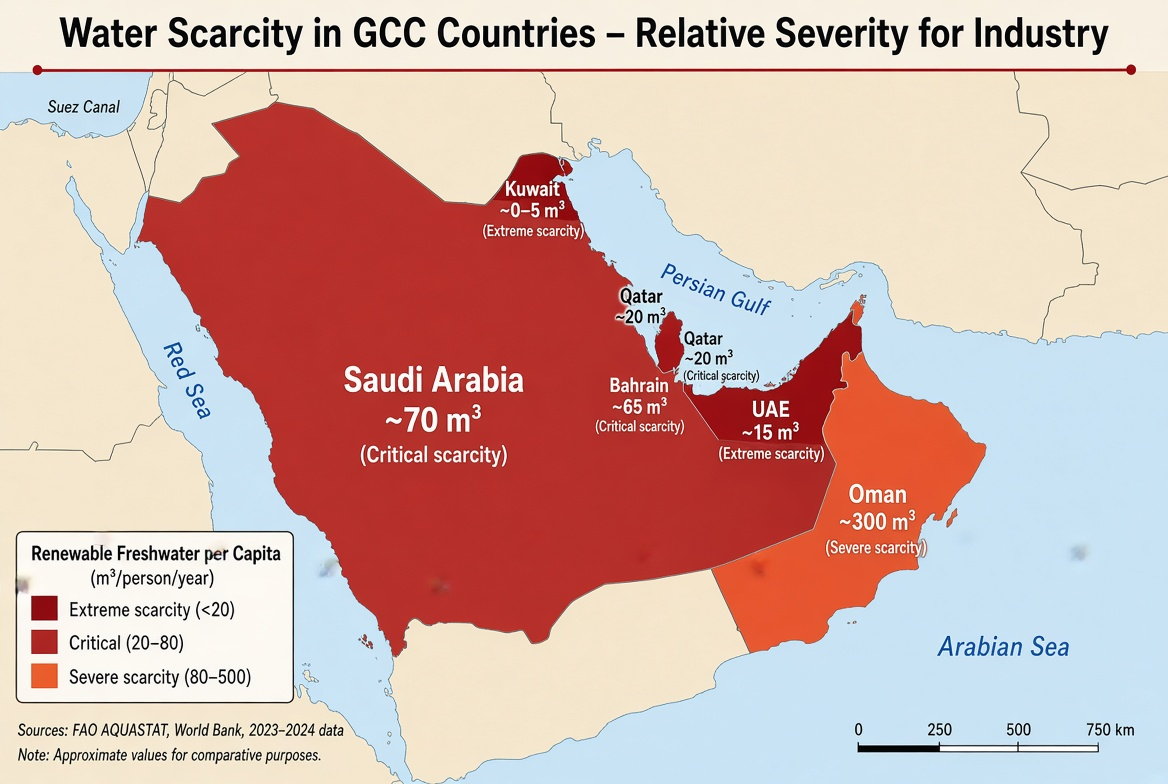
Water availability has become an increasingly important consideration in industrial development, particularly across the Gulf Cooperation Council (GCC) countries. High ambient temperatures, limited freshwater resources, growing industrial demand, and the cost of water supply have encouraged industries to reconsider the design and operation of their cooling systems.
Industrial cooling towers are among the major water-consuming components in many manufacturing facilities. They operate partly on evaporation, transferring heat from circulating water to the atmosphere. Although this process provides effective heat rejection, it also creates continuous water demand through evaporation, blowdown, and drift losses.
Traditionally, the primary objective of cooling system design has been to achieve the required process temperature at an acceptable initial investment. Today, however, designers must consider water consumption, energy efficiency, and long-term operating costs together.
Hybrid and adiabatic cooling technologies offer two engineering approaches to this challenge. In this article:
- A hybrid cooling tower combines a dry (air-cooled) section and an evaporative (wet) section in one system, so that part of the process heat is rejected without evaporating water.
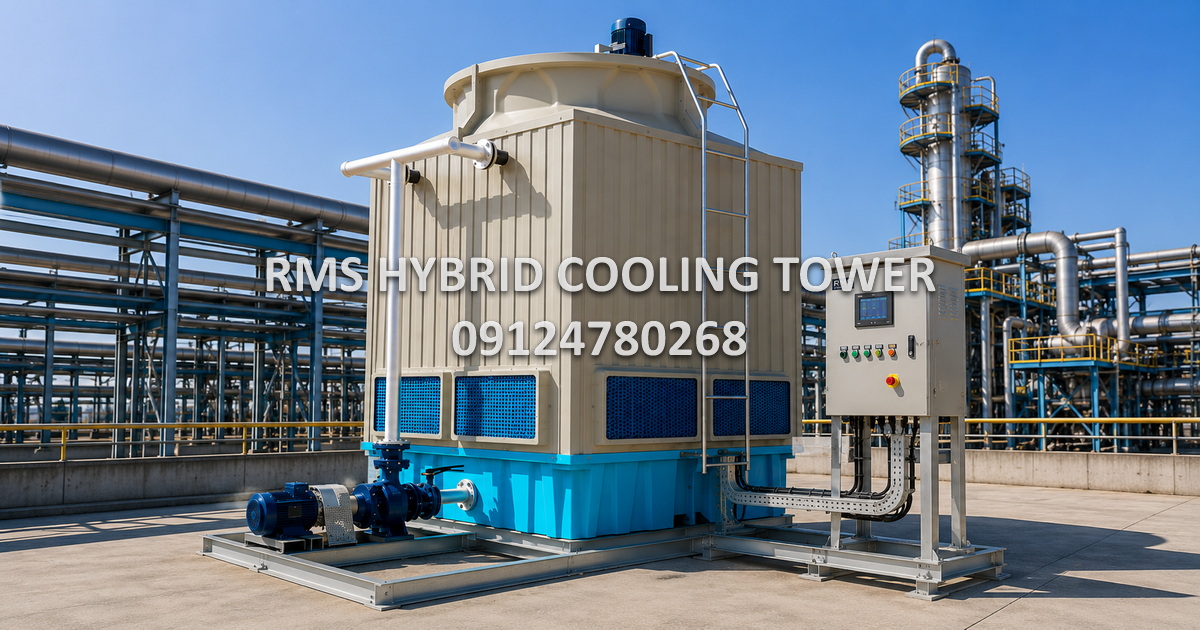
- An adiabatic cooling tower is fundamentally an air-cooled heat exchanger whose incoming air is pre-cooled by controlled water evaporation.
Both can reduce dependence on evaporative cooling, but they do so through different heat-transfer mechanisms. Understanding these differences is essential when selecting an appropriate solution for industrial facilities operating in hot climates.
2. Understanding Water Consumption in Conventional Cooling Towers
In conventional evaporative cooling towers, heat is rejected primarily through direct contact between water and air. A portion of the circulating water evaporates, absorbing latent heat and reducing the temperature of the remaining water.
The total make-up water requirement is determined by three principal losses:
- Evaporation losses
- Blowdown losses
- Drift losses
The basic water balance is:
Make-up water = Evaporation + Blowdown + Drift
Evaporation is an essential part of the cooling process and cannot simply be eliminated without changing the heat-rejection method. As a first approximation, the evaporation rate can be estimated from the heat rejected by evaporation:
m_evap ≈ Q_evap / h_fg, with h_fg ≈ 2,400 kJ/kg
This is an approximation: part of the heat rejected in a wet section is sensible rather than latent, so the actual evaporation rate is somewhat lower.
Blowdown is required to control the concentration of dissolved minerals in circulating water. As evaporation removes relatively pure water, dissolved solids remain in the system and become increasingly concentrated. A portion of the circulating water must therefore be discharged to prevent excessive scaling and corrosion. For a given number of cycles of concentration (COC):
B ≈ E / (COC − 1) − D
where B is the blowdown rate, E the evaporation rate and D the drift loss.
Drift consists of small water droplets carried out of the cooling tower with the exhaust air. Proper drift eliminators can significantly reduce this loss.
Conventional cooling towers remain effective and economically attractive for many industrial applications. Nevertheless, in facilities where water availability is limited or water supply costs are high, reducing the amount of heat rejected through evaporation can provide substantial operational benefits. This is where alternative cooling configurations become particularly relevant.
3. Hybrid Cooling Towers: Reducing Evaporation Through Dry Heat Rejection
A hybrid cooling tower combines dry and evaporative heat-rejection sections within one cooling system.
In many closed-circuit hybrid designs, the process fluid first passes through an air-cooled (dry) heat exchanger, where heat is transferred to ambient air without evaporation of water. Depending on the ambient conditions and the required process temperature, the fluid may then pass through an evaporative cooling section, where additional heat is removed through water evaporation. Series arrangements are common, but parallel and other arrangements also exist.
This allows the system to distribute its total thermal load between two mechanisms:
- Sensible heat transfer to ambient air through the dry section.
- Evaporative heat rejection through the wet section.
The fundamental principle is straightforward: not all the heat generated by an industrial process needs to be rejected through evaporation.
When ambient conditions are favorable, the dry section can remove a considerable portion of the thermal load. Consequently, the evaporative section operates less frequently or at a lower thermal duty, reducing the amount of water required.
3.1 Three Operating Modes
A properly designed hybrid cooling tower can operate under three general conditions.
Dry operation. When the ambient dry-bulb temperature is sufficiently below the process fluid temperature, the dry heat exchanger may provide the required cooling without activating the water distribution system. Under these conditions, evaporative water consumption can be eliminated while the required heat rejection is maintained.
Wet operation. During periods of high ambient temperature or high process heat load, dry cooling alone may not provide the required capacity. The evaporative section is then activated to achieve the required process temperature.
Combined operation. Under intermediate conditions, both sections operate simultaneously. The dry heat exchanger removes part of the thermal load, while the evaporative section handles the remaining duty.
An effective control strategy adjusts the contribution of each section according to ambient temperature, process load, and required leaving-fluid temperature. The objective is not necessarily to maximize dry cooling at every moment, but to achieve an appropriate balance between water consumption, electrical energy, and cooling performance.
3.2 The Importance of Dry Coil Sizing
One of the most important design parameters in a hybrid cooling tower is the thermal capacity of its dry heat exchanger. Simply installing an air-cooled coil above a conventional cooling tower does not automatically result in a water-efficient system.
If the dry section is undersized, it may not remove a sufficient portion of the thermal load during favorable ambient conditions, and the evaporative section will operate for more hours than expected. Conversely, an excessively large dry heat exchanger increases equipment dimensions, initial investment, air-side pressure drop and fan power.
Therefore, dry coil sizing should be based on an annual operating assessment rather than a single design condition. The following parameters should be considered:
- Process fluid inlet and outlet temperatures
- Required thermal duty
- Ambient dry-bulb and wet-bulb temperatures
- Available airflow and fan performance
- Heat exchanger surface area
- Annual operating hours
- Expected water-saving targets
A well-engineered hybrid system should maximize the useful contribution of dry cooling without creating unnecessary capital or energy costs.
4. Adiabatic Cooling: Improving Air-Cooled Heat Exchanger Performance
Adiabatic cooling provides another approach to reducing water consumption in industrial heat-rejection systems. Unlike a hybrid cooling tower, which transfers part of the process heat through a dry coil and the remainder through an evaporative section, an adiabatic air cooler uses water primarily to reduce the temperature of the incoming air before it reaches the heat exchanger.
In a typical adiabatic system, ambient air passes through wetted evaporative pads or a controlled water-spray section. A portion of the water evaporates, converting sensible heat of the air into latent heat. As a result, the air dry-bulb temperature falls at nearly constant enthalpy, approaching (but never reaching) the wet-bulb temperature, depending on the effectiveness of the evaporative section.
The pre-cooled air then passes through the heat exchanger, improving the temperature difference between the process fluid and the cooling air. This can increase heat-rejection capacity or allow the required thermal duty to be achieved at higher ambient dry-bulb temperatures.
4.1 Main Types of Adiabatic Systems
Adiabatic cooling systems can be classified according to how evaporative cooling is applied.
Evaporative pad cooling. Ambient air passes through wetted pads before entering the heat exchanger. Water is distributed over the pad surface, and a portion evaporates as air moves through the material. This provides relatively uniform air pre-cooling when pad selection, water distribution and airflow are properly designed. Scaling and biological growth on pads must be managed through water treatment and maintenance.
Direct water-spray cooling. Water is atomized through nozzles and introduced into the incoming airflow, and evaporation reduces the air temperature before it reaches the heat exchanger. Nozzle selection, droplet size, residence time, water quality and control of spray operation are important design considerations. Droplets that do not evaporate can reach the fins and cause scaling and corrosion, and direct spray systems may be less suitable for heavily dust-laden environments unless appropriate filtration and maintenance provisions are incorporated.
Indirect adiabatic cooling. Evaporation takes place in a separate air stream. Cooling is transferred to the primary air through a heat exchanger without direct contact between the evaporative water and the primary airflow. This is particularly useful when maintaining separation between the two air streams is important.
The appropriate configuration depends on process requirements, environmental conditions, water quality and maintenance considerations.
4.2 The Role of Wet-Bulb Temperature
The performance of direct adiabatic cooling is strongly influenced by the difference between ambient dry-bulb and wet-bulb temperatures. This difference (the wet-bulb depression) represents the theoretical potential for evaporative air cooling:
ΔT_dep = T_db − T_wb
where T_db is the ambient dry-bulb temperature, T_wb is the ambient wet-bulb temperature and ΔT_dep is the wet-bulb depression. The larger this difference, the greater the potential for reducing incoming air temperature through direct evaporative cooling.
Actual performance depends on the saturation effectiveness (ε) of the evaporative pads or spray system, expressed as a fraction between 0 and 1:
ε = (T_db − T_out) / (T_db − T_wb)
where T_out is the air temperature leaving the evaporative section. Rearranged, the leaving-air temperature is:
T_out = T_db − ε × (T_db − T_wb)
Example. Consider a dry-bulb temperature of 40 °C, a wet-bulb temperature of 24 °C and a pad saturation effectiveness of 80% (ε = 0.80):
T_out = 40 − 0.80 × (40 − 24) = 40 − 12.8 = 27.2 °C
The air temperature therefore decreases from 40 °C to approximately 27.2 °C before entering the heat exchanger, which can substantially improve the operating conditions of an air-cooled heat exchanger.
This equation applies to direct evaporative pre-cooling. Indirect adiabatic systems require a separate heat-transfer assessment based on their particular exchanger configuration.
5. Hybrid vs. Adiabatic Cooling: Understanding the Engineering Differences
Although hybrid and adiabatic systems share the objective of reducing dependence on conventional evaporative cooling, their operating principles are different. A hybrid cooling tower reduces water consumption by transferring part of the process heat directly to ambient air through a dry heat exchanger. An adiabatic air cooler uses controlled water evaporation to reduce incoming air temperature and improve the performance of a dry heat exchanger.
Parameter | Hybrid Cooling Tower | Adiabatic Cooler |
|---|---|---|
Main cooling mechanism | Dry and evaporative heat rejection | Dry heat exchange with evaporative air pre-cooling |
Water consumption | Reduced by increasing dry heat rejection | Controlled and dependent on adiabatic operation |
Dry operation | Possible when ambient conditions permit | Possible when air cooling alone meets the duty |
Main heat-transfer components | Dry coil and evaporative cooling section | Air-cooled coil and evaporative pre-cooling section |
Wet-bulb temperature influence | Important for evaporative performance | Critical for air pre-cooling potential |
Main design challenge | Dry coil capacity and operating strategy | Pad or spray effectiveness and airflow |
Maintenance requirements | Coil, water distribution and heat-rejection equipment | Pads, water distribution, filtration and heat exchanger |
Typical application | Industrial process cooling with significant water-saving requirements | Air-cooled industrial heat rejection in hot environments |
The two technologies should not be treated as interchangeable solutions.
A project requiring a leaving-fluid temperature with a small approach to the ambient wet-bulb temperature may favor an evaporative or hybrid cooling tower configuration. Because an adiabatic air cooler is limited by the pre-cooled air temperature plus the coil approach, it is better suited to processes that tolerate a higher leaving-fluid temperature.
The final decision should be based on actual process requirements rather than the equipment name alone.
6. Climate Considerations across the GCC countries
Climate conditions across the Gulf region vary considerably. Although high ambient temperatures are common, relative humidity, wet-bulb temperature and seasonal operating patterns differ between coastal and inland locations. These differences directly influence the performance and water-saving potential of hybrid and adiabatic cooling systems.
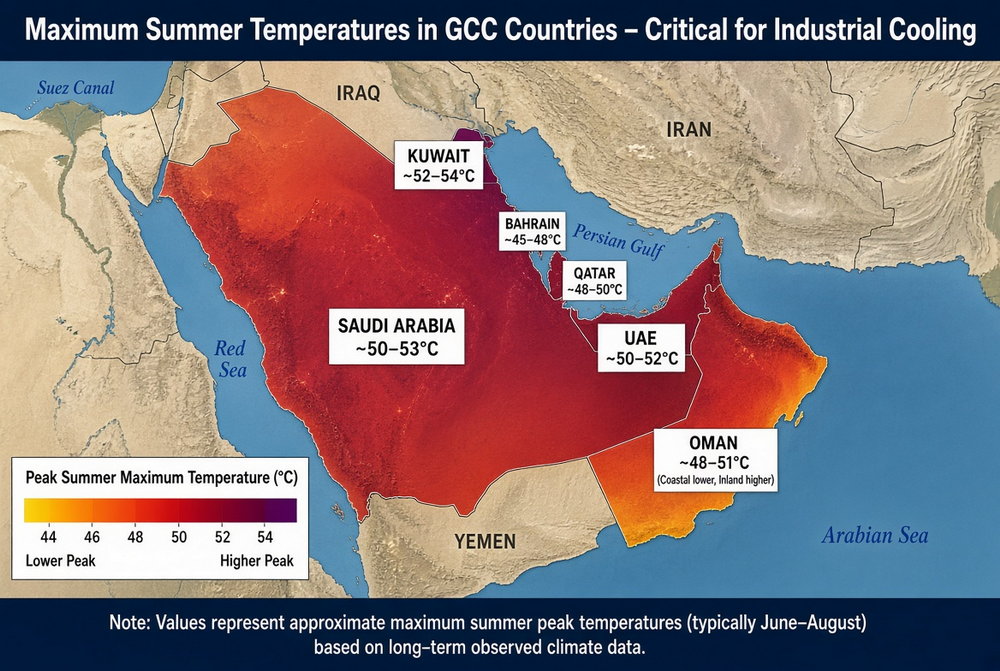
6.1 Coastal Areas: Muscat, Dubai and Doha
Coastal locations often experience high humidity, particularly during summer. When the ambient wet-bulb temperature approaches the dry-bulb temperature, the potential for direct evaporative air pre-cooling becomes limited. Under these conditions, adiabatic systems may achieve a smaller reduction in incoming air temperature than they would in dry inland environments.
However, this does not automatically make them unsuitable. Actual performance must be evaluated using coincident dry-bulb and wet-bulb design conditions, rather than maximum dry-bulb temperature alone. Hybrid cooling towers may also provide water savings through dry heat rejection during cooler nights and favorable seasonal conditions.
Coastal sites also expose equipment to salt-laden air. Chloride-induced corrosion of fins, coils and structural components should be addressed through appropriate material selection and protective coatings.
6.2 Inland and Arid Areas: Riyadh and Other Interior Regions
In many inland areas, the difference between dry-bulb and wet-bulb temperatures can be considerably greater, creating favorable conditions for adiabatic pre-cooling. During a hot and relatively dry period, an evaporative pad system may significantly reduce the air temperature entering the heat exchanger, improving heat-rejection performance without continuous operation of a conventional evaporative cooling section.
At the same time, very high summer dry-bulb temperatures mean that dry cooling alone often cannot meet the duty at peak conditions, which is exactly where adiabatic pre-cooling adds value. Dust and sand storms must also be considered in filtration and maintenance planning.
Hybrid cooling towers can also benefit from the seasonal and daily variation in ambient temperatures, particularly when industrial facilities operate throughout the year.
6.3 Oman: Evaluating Different Regional Conditions
Oman illustrates why a single configuration cannot be assumed suitable nationwide: humid coastal sites such as Muscat and drier inland sites differ markedly in humidity and wet-bulb temperature.
For facilities located in relatively dry inland environments, adiabatic pre-cooling may offer substantial benefits. In coastal areas, the feasibility of adiabatic cooling should be assessed using actual design weather data and annual operating profiles. For industrial applications with high process-water temperatures and significant seasonal operating hours, a properly sized hybrid cooling tower may provide an attractive balance between dry heat rejection and evaporative cooling.
The most important requirement is to evaluate the local climate together with the actual process load.
7. Estimating Annual Water Consumption and Potential Savings
One of the most common mistakes in evaluating water-saving cooling systems is relying on performance at a single design temperature. A system may operate with very low water consumption during favorable ambient conditions but require significantly more water during hot periods. Annual water consumption is therefore a more meaningful performance indicator than instantaneous water-saving percentages.
7.1 Water Consumption in Hybrid Cooling Towers
In a hybrid cooling tower, annual water consumption depends largely on the proportion of total heat rejected through the evaporative section. A simplified heat balance is:
Q_total = Q_dry + Q_evap
where Q_total is the total heat-rejection requirement, Q_dry is the heat rejected through the dry section, and Q_evap is the heat rejected through the evaporative (wet) section, which is mostly latent heat with a smaller sensible portion.
As the contribution of dry cooling increases, the thermal load handled by the evaporative section decreases, which generally reduces evaporation and the associated make-up water requirement. However, the actual annual saving depends on dry coil capacity, ambient conditions, process load and control strategy.
7.2 Water Consumption in Adiabatic Systems
In adiabatic air coolers, water is consumed primarily when the evaporative pre-cooling system is activated. During cooler periods, the equipment may operate entirely as a conventional air-cooled heat exchanger. When ambient temperature increases and the cooling capacity of the dry coil becomes insufficient, the control system activates the pads or spray system.
The water evaporated in direct pre-cooling can be estimated from the humidity increase of the air:
m_water ≈ m_air × (ω_out − ω_in)
where m_air is the dry-air mass flow and ω is the humidity ratio (kg water per kg dry air). For the example in Section 4.2 (40 °C dry-bulb, 24 °C wet-bulb, ε = 0.80), this is roughly 5.4 g of water per kg of dry air. This is an approximate figure.
Water consumption therefore depends on:
- Ambient dry-bulb and wet-bulb temperatures
- Airflow through the evaporative section
- Pad saturation effectiveness
- Water distribution and recirculation arrangement
- Operating hours under adiabatic conditions
- Process heat load
- Control setpoints
It is also important to distinguish between water evaporation and total water consumption. In recirculating pad systems, not all supplied water evaporates. Additional losses may occur through drainage, periodic flushing and maintenance activities, and these should be included in a complete water balance.
7.3 Why Annual Operating Profiles Matter
A reliable assessment should divide the year into representative operating periods. For each period, the engineer should determine:
- Ambient dry-bulb and wet-bulb temperatures
- Required process cooling capacity
- Available dry cooling capacity
- Whether evaporative or adiabatic operation is necessary
- Expected water consumption
- Electrical energy consumption
The annual water requirement can then be calculated by summing consumption across the operating hours of each period. The percentage of water saved should be calculated against a clearly defined reference system providing the same cooling duty and process temperatures. This is particularly important when comparing systems operating in different climates or under different load conditions.
8. Balancing Water Savings, Energy Consumption and Investment Costs
Reducing water consumption is important, but water efficiency should not be evaluated independently of electrical energy consumption and capital investment.
Hybrid cooling towers may require larger heat exchangers, additional fans and more sophisticated control systems. Increasing dry coil capacity can improve water savings, but it may also increase equipment size, air-side pressure drop and fan power. Similarly, adiabatic air coolers require water distribution systems, pads or spray equipment, and appropriate maintenance arrangements. Their electrical performance depends on airflow requirements, fan efficiency and the additional pressure drop introduced by the evaporative section.
A comprehensive economic evaluation should therefore consider:
- Initial equipment and installation costs
- Annual water consumption and water supply costs
- Electrical energy consumption
- Water treatment requirements
- Maintenance and replacement of components
- Expected operating life
- Local water availability and supply restrictions
In some industrial facilities, the value of reducing water consumption may justify a higher initial investment. In others, a conventional cooling tower with an optimized water-treatment and blowdown-control strategy may remain the more economical option. The correct solution is always project-dependent.
9. Key Design Considerations for Industrial Facilities in the GCC
Selecting a suitable hybrid or adiabatic cooling system requires a detailed engineering assessment. The following considerations are particularly important for industrial projects in the GCC countries and the wider Persian Gulf region.
Process temperature requirements. The required inlet and outlet temperatures of the process fluid determine whether dry cooling alone can satisfy the thermal duty.
Coincident climatic conditions. Dry-bulb temperature, wet-bulb temperature and relative humidity should be evaluated together using reliable local weather data.
Annual operating schedule. Facilities operating continuously throughout the year may benefit more from seasonal dry cooling than facilities operating only during a limited summer period.
Water quality and treatment. High mineral content and suspended solids can cause scaling, clogging and deterioration of evaporative components. Water treatment, filtration and biological control, including Legionella risk management for any system in which water contacts air, should be established at the design stage.
Dust, sand and salt exposure. Dust accumulation can reduce heat exchanger performance and obstruct evaporative pads, which is particularly relevant in desert environments. In coastal areas, salt-laden air adds corrosion risk. Appropriate filtration, protective coatings, access for cleaning and maintenance planning are essential.
Control strategy. Automatic control should determine when dry cooling is sufficient and when evaporative or adiabatic assistance is required. The control system should respond to actual operating conditions rather than relying solely on fixed seasonal schedules.
Heat exchanger design. The thermal capacity, surface area, material selection, airflow and pressure drop of the heat exchanger have a direct influence on overall performance.
Ultimately, the best design is not necessarily the one with the lowest theoretical water consumption. It is the one that achieves the required process cooling performance with an economically and operationally acceptable balance of water, energy and maintenance.
10. Conclusion
Hybrid cooling towers and adiabatic air coolers represent two important engineering approaches to improving water efficiency in industrial cooling applications.
Hybrid cooling towers reduce water consumption by transferring part of the process heat through a dry heat exchanger, thereby reducing the thermal load handled by the evaporative section. Adiabatic systems improve the performance of air-cooled heat exchangers by using controlled water evaporation to reduce the temperature of incoming air. Although their operating principles differ, both can reduce dependence on conventional evaporative cooling when properly designed and applied.
For industries across the GCC region, their effectiveness depends strongly on local climatic conditions, process temperature requirements, annual operating hours and the relationship between water and energy costs. A meaningful comparison should therefore be based on annual performance calculations rather than isolated design-point values or general water-saving claims.
The objective should not simply be to use less water, but to reject industrial heat most efficiently and sustainably possible.
References
- U.S. Department of Energy. Best Management Practice #10: Cooling Tower Management. https://www.energy.gov/cmei/femp/best-management-practice-10-cooling-tower-management
- ASHRAE Handbook. Chapter 41: Evaporative Air-Cooling Equipment. https://handbook.ashrae.org/handbooks/S24/IP/s24_ch41/s24_ch41_ip.aspx
- U.S. Environmental Protection Agency. WaterSense at Work: Best Management Practices for Commercial and Institutional Facilities – Cooling Towers. https://www.epa.gov/system/files/documents/2023-05/ws-commercial-watersense-at-work_Section_6.3_Cooling_Towers.pdf
- RMS Cooling. Hybrid Cooling Tower: A Solution for Reducing Water Consumption.
- RMS Cooling. Adiabatic Cooling Tower: Low-Water-Consumption Industrial Cooling.
About the Author
Mohammad Ghorbanalibeik is an industrial cooling systems specialist with experience in the design and development of cooling towers, hybrid cooling systems, air coolers and industrial heat-rejection equipment. His professional interests include thermal system optimization, water conservation and the engineering of industrial cooling solutions for challenging climatic conditions.
RMS Cooling – Industrial Cooling Equipment Design and Manufacturing
Website: https://rms-cooling.ir/
Email: info@rms-cooling.ir