
Introduction: Industrial Cooling Solutions for Iraq's Climate
Iraq's industrial sector operates under some of the most challenging climatic conditions in the Middle East. Extremely high summer temperatures, limited water resources, airborne dust, sandstorms, and variations in raw water quality make industrial cooling an important engineering consideration.
Industries such as oil and gas, petrochemicals, power generation, steel manufacturing, cement production, food processing, and chemical industries require reliable cooling systems to maintain stable production conditions and protect sensitive equipment.
Industrial cooling towers and air-cooled heat exchangers are two of the most widely used technologies for removing heat from circulating water and industrial process fluids. However, selecting the appropriate system requires more than simply calculating the nominal cooling capacity. Local dry-bulb temperature, wet-bulb temperature, water availability, water chemistry, dust concentration, operating pressure, and process requirements must all be considered.
RMS Cooling provides engineering and manufacturing solutions for industrial cooling applications, including open-circuit cooling towers, closed-circuit cooling towers, hybrid cooling towers, cross-flow cooling towers, and industrial air coolers.
This article examines the climatic conditions of different Iraqi regions, the engineering requirements of industrial cooling systems, and the most suitable cooling solutions for factories and industrial facilities throughout Iraq.
1. Climate Conditions in Different Regions of Iraq
Iraq has varied climatic conditions. The southern, central, western, and northern regions experience different combinations of temperature, humidity, elevation, and seasonal weather patterns.
These differences have a direct impact on the thermal performance and design requirements of industrial cooling equipment.
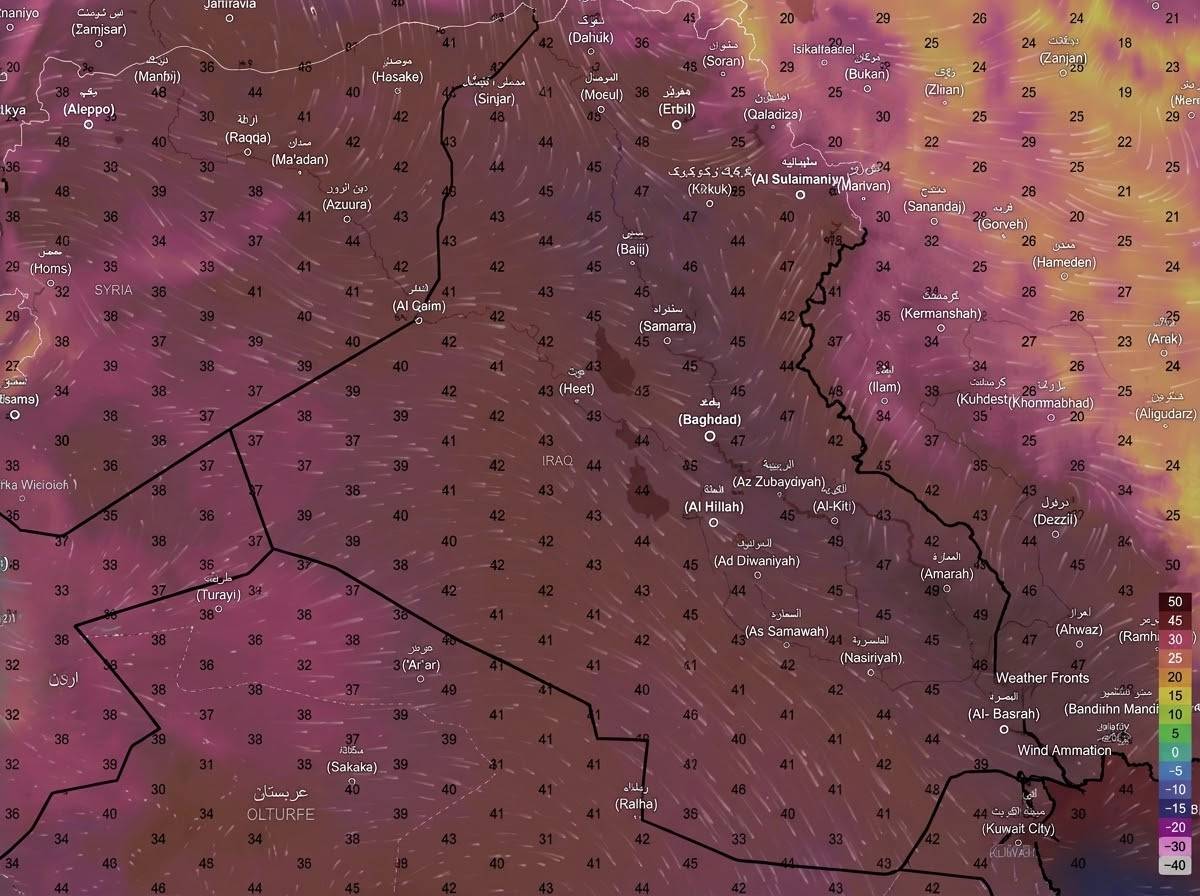
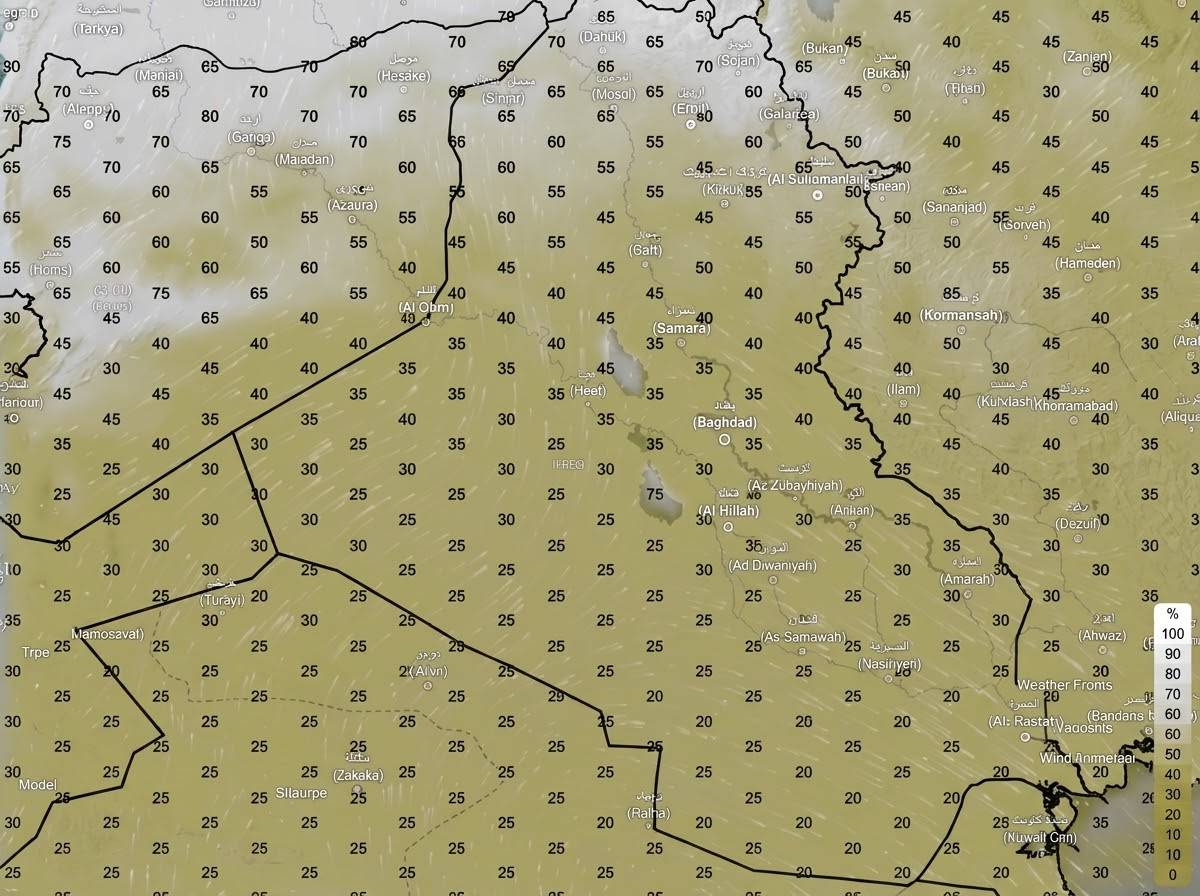
Southern Iraq: Basra, Nasiriyah, and Al-Amarah
Southern Iraq experiences extremely hot summers, with Basra being one of the most challenging locations for industrial cooling system design.
During July and August, outdoor dry-bulb temperatures in Basra can reach approximately 47–48°C, while extreme conditions can approach or exceed 50°C.
Unlike the central and western desert regions, Basra is influenced by its proximity to the Persian Gulf. Consequently, humidity can be relatively high, particularly during certain summer periods.
This combination of high temperature and humidity is particularly important when selecting evaporative cooling equipment.
A higher wet-bulb temperature reduces the cooling potential of a conventional cooling tower. Therefore, a tower designed for a dry inland location may not achieve the same cold-water temperature when installed in Basra.
Important considerations for cooling systems in southern Iraq include:
High summer dry-bulb temperatures.
Relatively high wet-bulb temperatures during humid periods.
High evaporation rates and significant makeup water requirements.
Potentially high salinity and dissolved mineral concentrations in available water sources.
Frequent exposure to airborne dust and sand.
The need for reliable operation in oil, gas, petrochemical, and power-generation facilities.
Central Iraq: Baghdad, Karbala, Najaf, and Hilla
Central Iraq has a predominantly hot and dry continental climate.
In Baghdad, summer afternoon temperatures frequently exceed 40°C, with average daily maximum temperatures reaching approximately 43–45°C during July and August. More extreme conditions may approach 48°C.
Relative humidity is generally lower than in Basra, particularly during the afternoon.
This creates favorable conditions for evaporative cooling compared with humid coastal environments. However, high ambient temperatures still impose considerable thermal loads on cooling towers and air-cooled heat exchangers.
For industrial facilities in Baghdad and surrounding cities, cooling equipment should be selected based on the actual summer design conditions rather than annual average temperatures.
Water quality is also an important consideration, particularly where groundwater or other mineral-rich sources are used for cooling tower makeup.
Northern Iraq: Erbil, Duhok, and Mosul
Northern Iraq generally experiences lower summer temperatures than the southern and central regions, although extreme heat remains possible.
Erbil and Mosul can experience summer temperatures above 40°C, with peak daytime conditions occasionally reaching approximately 43–45°C.
The Kurdistan Region also has significant elevation differences, which influence local atmospheric conditions.
In comparison with southern Iraq, some northern locations offer more favorable wet-bulb conditions for evaporative cooling. However, this should not be assumed for every project.
The following factors should be evaluated:
Site elevation above sea level.
Local summer humidity.
Actual summer design dry-bulb and wet-bulb temperatures.
Seasonal variations in operating conditions.
Dust exposure and water quality.
Western Iraq: Anbar and Desert Industrial Locations
Western Iraq is characterized by a predominantly arid and desert climate.
Locations such as Ramadi, Rutba, and industrial facilities near desert regions may experience high summer temperatures, low humidity, and significant dust exposure.
The relatively low atmospheric humidity can improve the performance of evaporative cooling towers by providing a lower wet-bulb temperature compared with humid locations.
Nevertheless, water scarcity and the accumulation of dust on equipment are important challenges.
For remote industrial facilities, minimizing water consumption and simplifying maintenance can be major factors in selecting cooling equipment.
2. Summer Dry-Bulb and Wet-Bulb Temperatures in Iraq
Two atmospheric parameters are particularly important when designing an industrial cooling tower:
Dry-Bulb Temperature (DB): The actual air temperature measured using a conventional thermometer, protected from direct solar radiation.
Wet-Bulb Temperature (WB): The temperature reached through evaporative cooling of a wetted surface exposed to moving air. It represents an important limitation for evaporative cooling performance.
The difference between dry-bulb and wet-bulb temperatures indicates the potential for evaporative cooling.
In general, a larger difference provides greater evaporative cooling potential.
Summer Conditions for Selected Iraqi Cities
The following values provide representative summer conditions reported in an engineering climate study. They are useful for preliminary comparisons, but should not be treated as final equipment design conditions.
Summer Design Dry-Bulb and Wet-Bulb Temperatures in Major Iraq Cities
City | Maximum Summer Dry-Bulb (°C) | Summer Wet-Bulb (°C) |
|---|---|---|
Basra | 51-52 | 28-29 |
Nasiriyah | 50 | 24-25 |
Baghdad | 48 | 24.5-25 |
Najaf | 48 | 24.8 |
Kirkuk | 46 | 25.5 |
Mosul | 46-47 | 25.5-28 |
Sulaymaniyah | 45 | 22.5 |
Samawah | 50 | 24-26 |
These figures represent selected summer weather conditions and should not be confused with guaranteed extreme design values or ASHRAE annual exceedance design conditions.
For preliminary engineering, the designer should obtain reliable hourly weather data or appropriate climatic design percentiles for the exact project location.
For example, a cooling tower operating in Baghdad may be designed around a different wet-bulb temperature from an otherwise identical system installed in Basra.
This difference can significantly affect:
Cooling tower dimensions.
Heat transfer surface area.
Required airflow.
Fan power.
Water distribution requirements.
Achievable cold-water temperature.
Actual thermal capacity.
Why Wet-Bulb Temperature Is Critical for Cooling Tower Design
Unlike an air-cooled heat exchanger, an evaporative cooling tower can cool water below the ambient dry-bulb temperature.
However, under normal operating conditions, the cold-water temperature cannot be lower than the entering-air wet-bulb temperature.
Two important parameters are used to evaluate this performance:
Range:
Range = Hot Water Temperature − Cold Water Temperature
Approach:
Approach = Cold Water Temperature − Wet-Bulb Temperature
For example, consider an industrial cooling tower operating under the following conditions:
Hot water temperature: 40°C
Cold water temperature: 30°C
Entering-air wet-bulb temperature: 24°C
The resulting values are:
Range = 40 − 30 = 10°C
Approach = 30 − 24 = 6°C
These parameters are essential for determining the actual thermal requirements of the cooling tower.
A lower approach generally requires a larger heat transfer surface and more demanding equipment design.
For more information, see the RMS Cooling guide:
Cooling Tower: Principles, Design, and Selection
3. Open-Circuit Industrial Cooling Towers in Iraq
Open-circuit cooling towers are widely used in industrial applications because of their relatively simple construction, economical operation, and ability to handle large circulating water flow rates.
In an open cooling tower, hot process water is distributed over the fill material through spray nozzles. Air moves through the tower and comes into direct contact with the water.
A small portion of the circulating water evaporates, absorbing latent heat from the remaining water and reducing its temperature.
The cooled water is collected in the basin and returned to the industrial process.
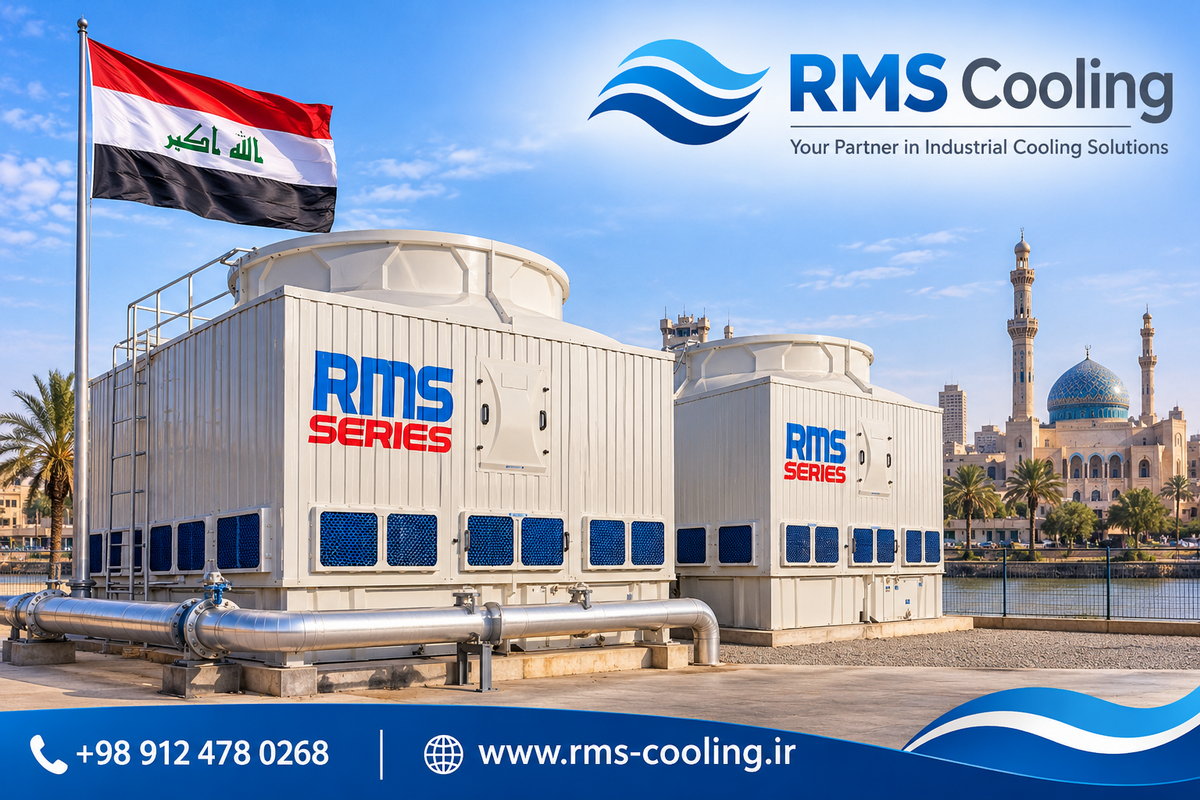
Advantages of Open Cooling Towers
Open cooling towers offer several advantages for Iraqi industrial facilities:
Suitable for high circulating water flow rates.
Economical initial investment compared with many indirect cooling arrangements.
Relatively simple mechanical construction.
Suitable for steel, cement, chemical, and general manufacturing industries.
Flexible configurations, including counter-flow and cross-flow designs.
Important Design Considerations
Open cooling towers require appropriate water treatment and regular maintenance.
In Iraq, the following factors should be carefully evaluated:
Makeup water quality and mineral concentration.
Scaling and corrosion potential.
Dust accumulation in the water basin and distribution system.
Proper filtration and side-stream treatment where required.
Blowdown control and cycles of concentration.
Fill material selection according to water quality and operating temperature.
In locations where raw water contains high concentrations of dissolved minerals, untreated operation can result in scaling on fill surfaces, heat exchangers, and pipelines.
Therefore, a water treatment strategy should be considered an essential part of the cooling tower design rather than an optional maintenance measure.
4. Closed-Circuit Cooling Towers for Sensitive Industrial Equipment
Closed-circuit cooling towers are particularly useful when the circulating process fluid must remain isolated from the surrounding environment.
In this configuration, the primary cooling fluid passes through a heat exchanger coil, while secondary spray water circulates over the outside of the coil.
Heat is transferred from the primary circuit to the secondary water and then rejected to the atmosphere through evaporation.
The primary process fluid does not directly contact the outside air or spray water.
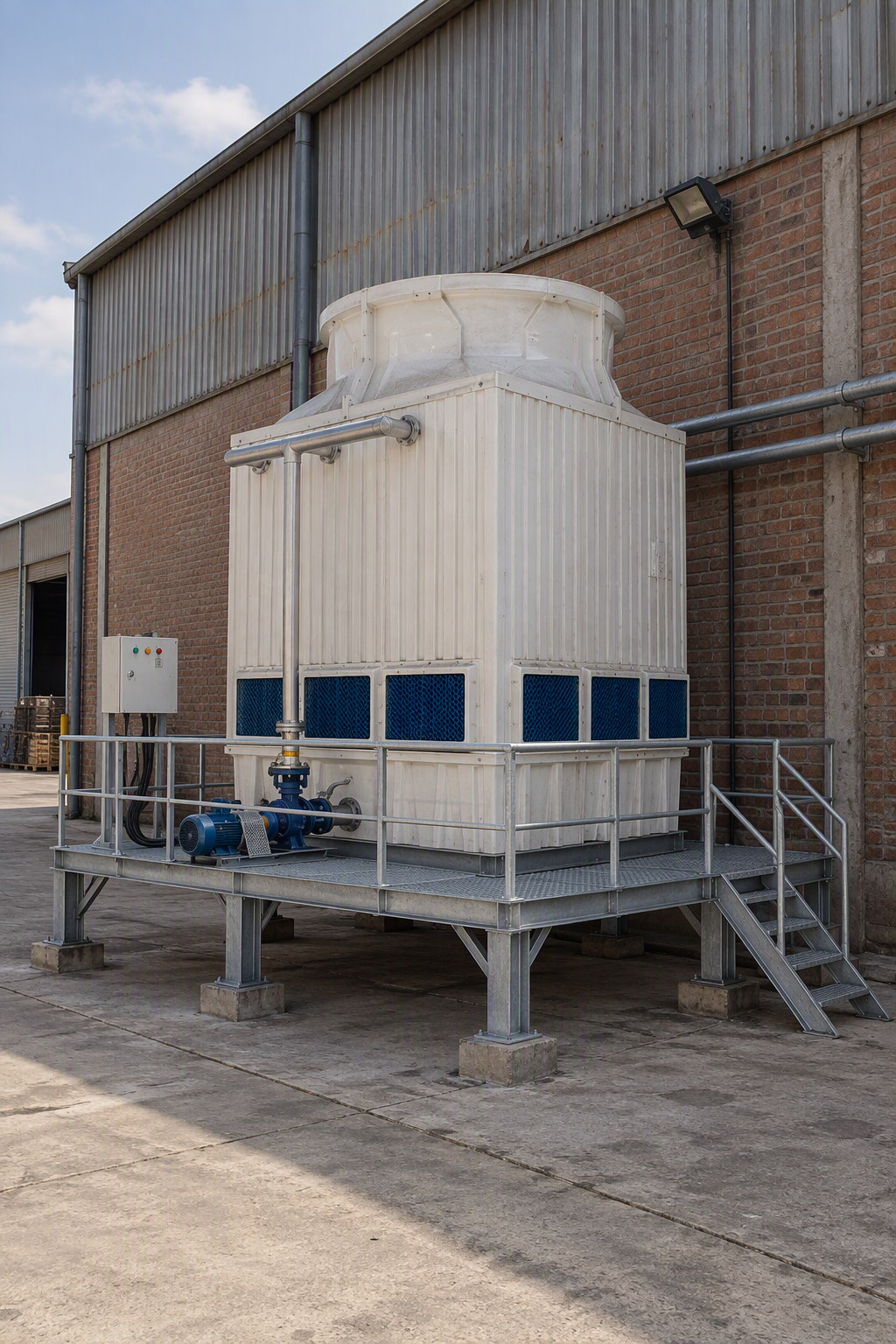
Why Closed-Circuit Cooling Towers Are Important in Iraq
Many industrial processes in Iraq involve expensive equipment that is sensitive to scale formation, contamination, and blockage.
Examples include:
Induction furnaces.
Industrial compressors.
Hydraulic systems.
External industrial chillers.
Specialized production machinery.
Certain power-generation and petrochemical processes.
Using a closed-circuit cooling tower can reduce contamination of the primary cooling water and help protect internal equipment passages.
It also allows the primary circuit to operate with properly treated water or a suitable water-glycol mixture where required.
However, the secondary spray-water circuit remains exposed to the environment and still requires water treatment and maintenance.
Coil Material Selection
The heat exchanger coil can be manufactured using different materials depending on water chemistry, pressure, temperature, and corrosion requirements.
Common options include:
Copper tubing.
Galvanized steel.
Stainless steel.
Material selection should be based on a chemical analysis of the water and the specific operating conditions.
For detailed technical information, visit:
Closed-Circuit Cooling Tower – Design, Operation, and Applications
5. Hybrid Cooling Towers: Reducing Water Consumption in Iraq
Water availability is one of the most important considerations for industrial projects in Iraq.
Conventional evaporative cooling towers require continuous makeup water to compensate for evaporation, blowdown, and drift losses.
In water-stressed regions, these requirements can increase operating costs and create limitations for industrial expansion.
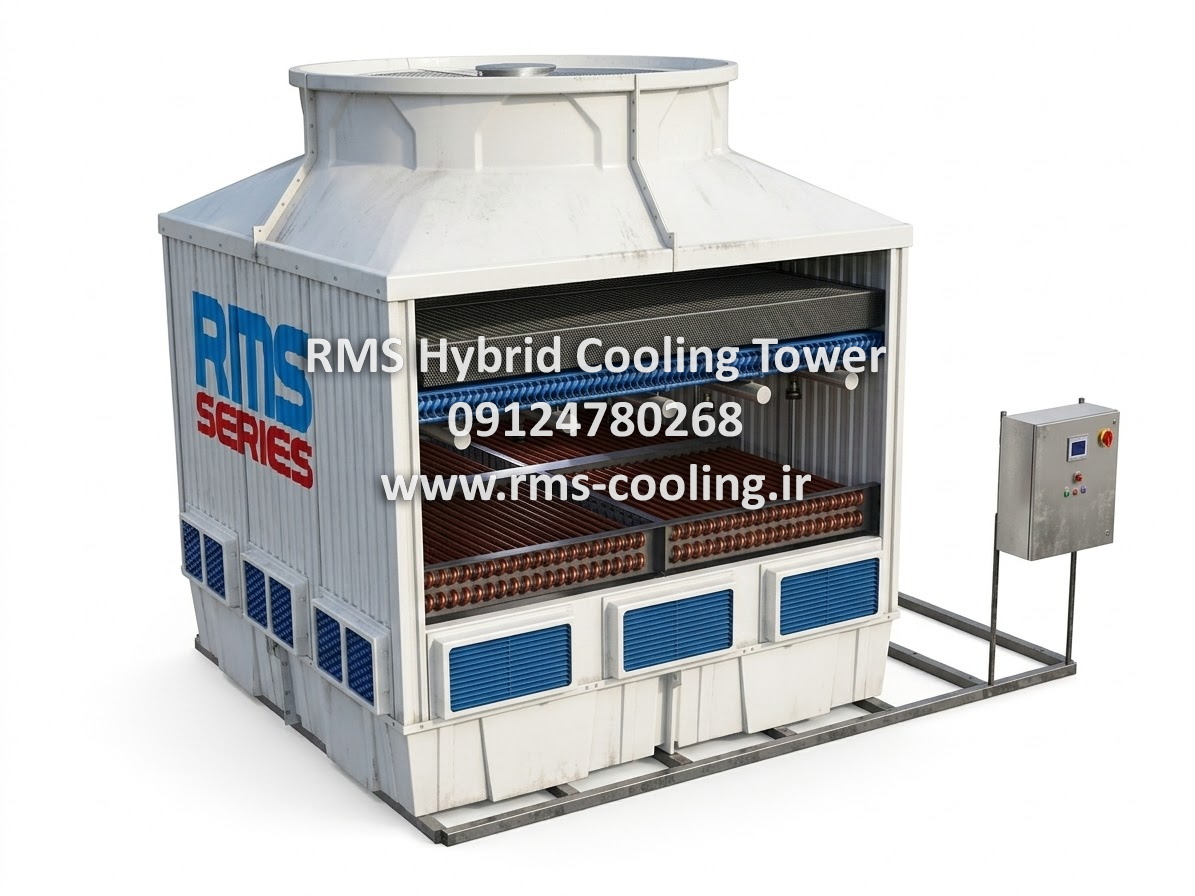
Hybrid cooling towers combine dry and evaporative cooling technologies to reduce dependence on water.
How Does a Hybrid Cooling Tower Work?
A hybrid cooling tower combines two heat rejection mechanisms:
Dry cooling through a heat exchanger coil exposed to airflow.
Evaporative cooling through a secondary water distribution system.
Depending on the ambient conditions and cooling demand, the system can operate in dry mode, wet mode, or a combination of both.
During favorable ambient conditions, the dry section can reject a significant portion of the heat without requiring spray-water evaporation.
When ambient temperatures increase and additional cooling is required, the evaporative section can be activated.
Benefits for Iraqi Industrial Facilities
Hybrid cooling towers can offer several advantages:
Reduced water consumption compared with conventional evaporative cooling systems under suitable operating conditions.
Improved flexibility during seasonal temperature variations.
Reduced evaporation losses during periods when dry cooling is sufficient.
Lower dependence on water resources.
Better suitability for industrial projects located in water-stressed areas.
The actual water-saving percentage depends on the local climate, operating schedule, process temperature, and system configuration. It should be calculated for each project rather than assumed from a general product specification.
For facilities in southern and central Iraq, hybrid cooling towers can be particularly interesting where water availability and operating costs are major concerns.
More technical information:
Hybrid Cooling Tower – Technology and Water-Saving Applications
6. Cross-Flow Cooling Towers for Industrial and Commercial Applications
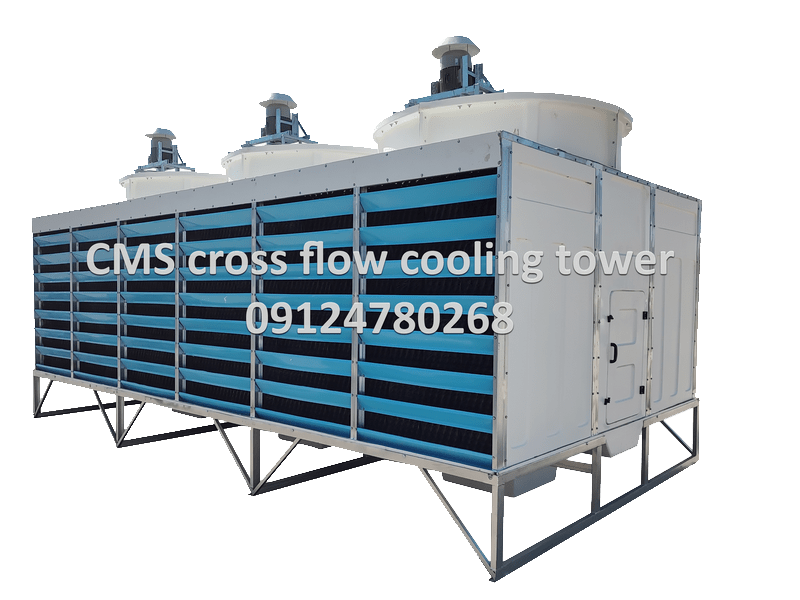
Cross-flow cooling towers are another option for industrial and commercial water cooling.
In a cross-flow arrangement, air moves horizontally through the fill while water flows vertically downward.
The air and water therefore move approximately perpendicular to each other.
Cross-flow designs are frequently selected for projects where accessibility, maintenance arrangements, and equipment layout are important.
Their internal configuration can provide convenient access to water distribution components and other serviceable parts.
However, cross-flow and counter-flow configurations should be compared based on the required thermal performance, available installation space, airflow arrangement, and project economics.
The selection should not be based solely on the tower configuration or nominal capacity.
Read more:
Cross-Flow Cooling Tower – Design and Applications
7. Industrial Air Coolers and Air-Cooled Heat Exchangers in Iraq
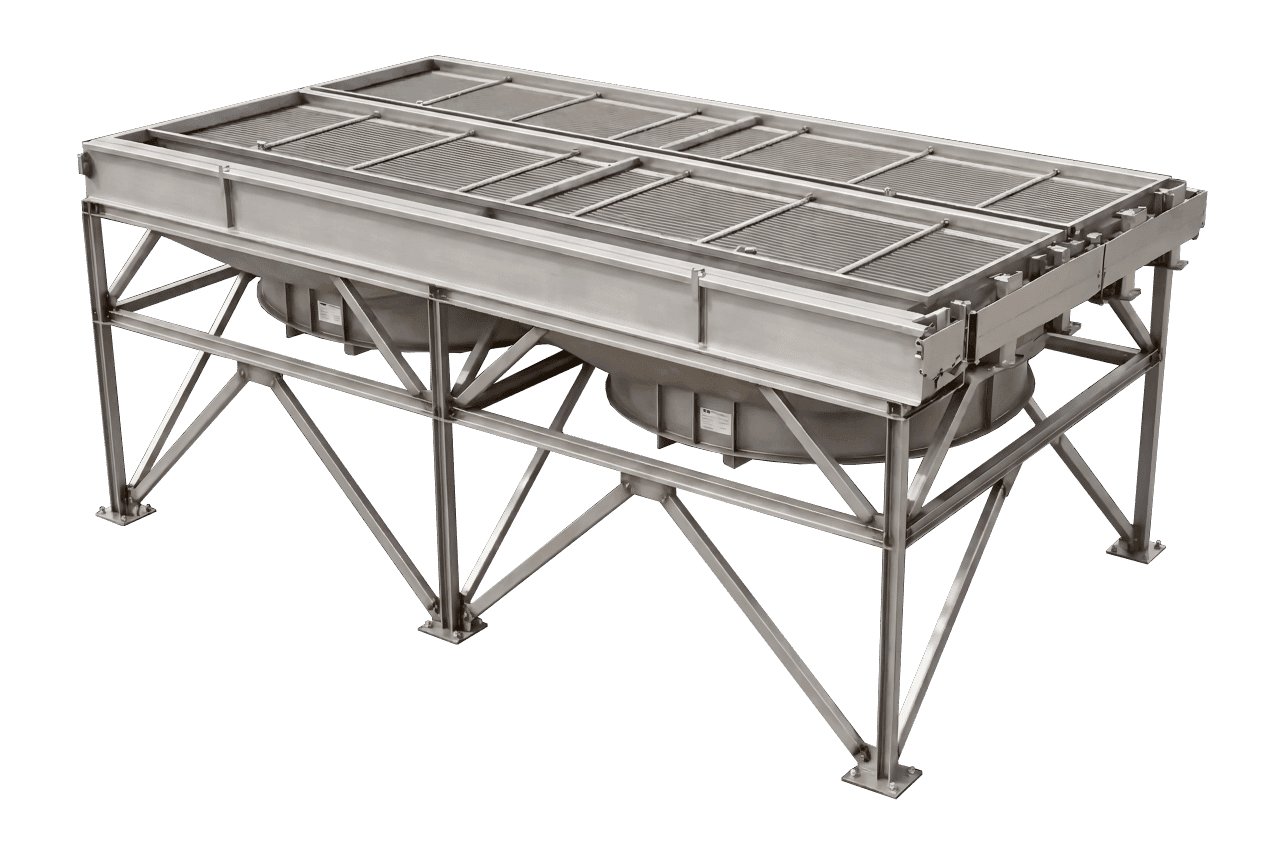
An industrial air cooler, also known as an Air-Cooled Heat Exchanger (ACHE), removes heat from a process fluid by transferring it directly to atmospheric air.
Unlike an evaporative cooling tower, an air cooler does not require continuous water evaporation.
The hot process fluid flows through finned tubes, while fans move ambient air across the external tube surfaces.
Heat transfers from the process fluid through the tube wall and fins to the surrounding air.
Air coolers are widely used in:
Oil and gas facilities.
Refineries.
Petrochemical plants.
Power stations.
Steel manufacturing.
Chemical industries.
Industrial water and oil cooling systems.
Advantages of Industrial Air Coolers in Iraq
The most important advantage of air-cooled heat exchangers is their low dependence on water.
This is particularly valuable in remote locations, desert industrial facilities, and projects where water treatment and supply costs are high.
Other advantages include:
No continuous evaporative water consumption.
No cooling tower blowdown.
No cooling tower spray-water system.
Reduced dependence on raw water quality.
Suitable for a wide range of industrial fluids.
Possibility of forced-draft and induced-draft configurations.
Limitations of Air Coolers in Extremely Hot Climates
Although air coolers offer important advantages, their performance is directly affected by ambient dry-bulb temperature.
An air cooler cannot normally cool a process fluid below the entering-air temperature.
For example, if the ambient air temperature reaches 47°C, cooling water to 30°C using a conventional air cooler is not achievable under normal conditions.
In such situations, the equipment may require a very large heat transfer surface, substantial airflow, or an alternative cooling arrangement.
This is one reason why evaporative cooling towers can be more effective for applications requiring water temperatures significantly below the ambient dry-bulb temperature.
For more information:
Industrial Air Coolers and Air-Cooled Heat Exchangers
8. Dust and Sandstorms: A Major Challenge for Cooling Equipment in Iraq
Dust and sandstorms are among the most important environmental challenges affecting industrial facilities throughout Iraq.
Central and southern Iraq are particularly exposed to dust events during spring and summer, while northern regions can also experience substantial summer dust activity.
Airborne particles can negatively affect both cooling towers and air-cooled heat exchangers.
Dust-Related Problems in Air Coolers
Air coolers use finned tube bundles to increase the heat transfer surface area.
The spaces between fins can gradually become contaminated by dust, sand, and other airborne particles.
This can lead to:
Reduced airflow through the finned surface.
Increased air-side pressure drop.
Reduced heat transfer efficiency.
Increased fan power requirements.
More frequent cleaning and maintenance.
Potentially reduced cooling capacity during peak summer operation.
In areas with high dust concentration, the design should consider:
Appropriate fin spacing.
Accessible cleaning arrangements.
Suitable fan and motor protection.
Structural resistance to local wind conditions.
Practical maintenance access.
Dust-resistant equipment layout.
Very dense fin arrangements may offer greater heat transfer surface area but can become more difficult to maintain in dusty environments.
Therefore, fin geometry should be selected by balancing thermal performance and cleaning requirements.
Dust-Related Problems in Cooling Towers
Cooling towers are also exposed to dust and airborne particles.
Dust can enter through air inlets and accumulate in the water basin, distribution system, and other internal components.
Possible consequences include:
Sediment accumulation in the basin.
Blockage of spray nozzles.
Contamination of circulating water.
Increased filtration requirements.
Sludge accumulation.
Reduced heat transfer performance.
For facilities operating in dusty regions, suitable water filtration, basin cleaning, accessible internal components, and effective maintenance procedures are essential.
9. Water Quality, Scaling, and Corrosion in Iraqi Cooling Towers
Water quality is one of the most important technical factors in selecting and operating industrial cooling towers in Iraq.
The chemical characteristics of water can vary significantly between different regions and sources.
Groundwater in some northern and northeastern areas is generally fresher and more bicarbonate-based, while water in central and southern parts of Iraq can have higher salinity and chloride concentrations.
The actual condition depends on the local water source and must be verified through laboratory analysis.
Common Water-Related Problems
1. Scaling
High concentrations of calcium, magnesium, bicarbonates, and other dissolved minerals can lead to mineral precipitation.
Calcium carbonate scaling is particularly important in evaporative cooling systems.
Scale deposits can form on:
Heat exchanger surfaces.
Cooling tower fill.
Spray nozzles.
Distribution pipes.
Process equipment.
These deposits reduce heat transfer efficiency and may increase maintenance costs.
2. Corrosion
High chloride concentrations, unsuitable pH, dissolved oxygen, and improper chemical treatment can increase corrosion risks.
The selection of construction materials must therefore be based on water chemistry and operating conditions.
3. Biological Growth
Open cooling systems can support biological growth when water treatment and maintenance are inadequate.
Effective water treatment, cleaning, and monitoring are necessary to control biological contamination.
Water Treatment Recommendations
A suitable cooling water treatment program may include:
Water softening where appropriate.
Reverse osmosis for selected high-TDS water sources.
Scale inhibitors.
Corrosion inhibitors.
Biocides.
Side-stream filtration.
Controlled blowdown.
Monitoring of pH, conductivity, hardness, and other relevant parameters.
The use of reverse osmosis should not be considered an automatic requirement for every cooling tower. Its economic and technical suitability must be evaluated through water analysis, operating requirements, and a water-treatment study.
A Real Industrial Consideration in Southern Iraq
A published study on cooling towers at the South Refineries Company in Basra investigated scaling and corrosion problems using actual plant data.
The research identified a tendency for calcium carbonate precipitation in cooling tower systems and evaluated reverse osmosis as a potential treatment solution.
This is an important example of why cooling tower design in Iraq must consider local water chemistry rather than relying only on thermal calculations.
10. Nominal Cooling Tower Capacity vs. Actual Cooling Capacity in Iraq
One of the most common mistakes in selecting industrial cooling towers is relying exclusively on nominal refrigeration tonnage.
A cooling tower advertised as a 500 RT unit does not necessarily provide 500 RT of actual cooling capacity under every operating condition.
Cooling tower capacity is dependent on several parameters:
Entering-air wet-bulb temperature.
Hot water temperature.
Cold water temperature.
Water flow rate.
Airflow rate.
Heat transfer surface area.
Equipment configuration.
Standard nominal ratings are generally based on specified reference conditions.
If the operating conditions differ from those reference conditions, actual performance may also differ.
Example: Cooling Tower Selection for Baghdad and Basra
Consider two industrial facilities that require the same circulating water flow rate and the same heat rejection duty.
One facility is located in Baghdad and the other in Basra.
Although the process requirements may be identical, the ambient wet-bulb temperatures can differ.
The cooling tower installed in Basra may require a larger heat transfer surface, different airflow conditions, or a different equipment configuration to achieve the same cold-water temperature.
Therefore, a cooling tower should always be selected based on its guaranteed thermal performance at the actual project conditions.
A nominal tonnage value alone is insufficient for technical evaluation.
For a detailed explanation:
Cooling Tower Capacity: Nominal vs. Actual RT
11. Cooling Tower or Air Cooler: Which Is Better for Iraq?
There is no single cooling technology suitable for every industrial application in Iraq.
The correct choice depends on the required process temperature, water availability, ambient conditions, operating costs, and maintenance requirements.
| Parameter | Open Cooling Tower | Closed-Circuit Cooling Tower | Hybrid Cooling Tower | Air-Cooled Heat Exchanger |
|---|---|---|---|---|
| Cooling mechanism | Evaporative | Indirect evaporative | Dry and evaporative | Sensible air cooling |
| Main circuit exposed to air | Yes | No | Depends on configuration | No direct fluid-air contact |
| Evaporative water consumption | Yes | Yes, secondary circuit | Reduced under suitable conditions | No |
| Sensitivity to water quality | High | Mainly secondary circuit | Depends on configuration | Low |
| Ability to cool below ambient dry-bulb | Yes | Yes | Yes, in evaporative mode | No |
| Typical application | High-flow industrial water | Sensitive process equipment | Water-constrained industrial projects | Oil, gas, and process fluids |
| Cost(price) | Low | Moderate | High | High |
Recommended Applications
Open Cooling Towers
Suitable for large industrial water circulation systems where economical heat rejection and high water flow rates are important.
Closed-Circuit Cooling Towers
Suitable for sensitive equipment and processes where maintaining clean primary cooling water is essential.
Hybrid Cooling Towers
Suitable for facilities where reducing water consumption is a major project objective.
Industrial Air Coolers
Suitable for processes where water conservation is essential and the required outlet temperature can be achieved with the available ambient air conditions.
In some projects, combining an air cooler with an evaporative cooling tower or another cooling system may provide a better overall solution.
12. Important Engineering Parameters for Industrial Cooling System Design
Before selecting a cooling tower or air cooler for an industrial project in Iraq, the following information should be established.
Process Information
Required cooling capacity (kW or RT).
Circulating water flow rate (m³/h).
Hot water inlet temperature.
Required cold water outlet temperature.
Operating pressure.
Continuous or intermittent operation.
Process fluid characteristics.
Climatic Information
Project location.
Summer design dry-bulb temperature.
Summer design wet-bulb temperature.
Site elevation.
Relative humidity.
Wind conditions.
Dust exposure.
Water Quality Information
Total dissolved solids (TDS).
Total hardness.
Calcium and magnesium concentrations.
Chloride concentration.
Sulfate concentration.
pH.
Conductivity.
Suspended solids.
Installation and Operational Requirements
Available installation area.
Electrical power availability.
Maintenance accessibility.
Noise limitations.
Corrosion protection.
Required operating life.
Water consumption limitations.
The cooling equipment should then be designed according to the actual project requirements rather than selected from a general product catalogue.
13. RMS Cooling: Industrial Cooling Equipment Design and Manufacturing
RMS Cooling provides engineering and manufacturing solutions for industrial cooling systems.
The company's activities cover cooling towers, closed-circuit cooling towers, hybrid cooling towers, cross-flow cooling towers, industrial air coolers, and related cooling equipment.
Our engineering approach focuses on selecting and designing equipment according to the actual thermal and operating conditions of each project.
For industrial projects in Iraq, this includes consideration of:
High summer temperatures.
Local wet-bulb conditions.
Water consumption requirements.
Water quality and scaling potential.
Dust and sand exposure.
Required process temperatures.
Equipment reliability and maintenance.
Rather than relying solely on nominal capacity, RMS Cooling evaluates the operating conditions that determine the actual thermal performance of the equipment.
Whether a project requires an industrial cooling tower for a steel factory, a closed-circuit cooling system for induction furnaces, a hybrid cooling tower for water conservation, or an air-cooled heat exchanger for an oil and gas facility, the equipment configuration should be selected according to the engineering requirements of the application.
Contact RMS Cooling
For industrial cooling tower and air cooler design, technical consultation, and manufacturing inquiries:
RMS Cooling
Email: info@rms-cooling.ir
Phone / WhatsApp: +989124780268
RMS Cooling – Your Partner in Industrial Cooling Solutions
14. حلول التبريد الصناعي في العراق: أبراج التبريد والمبردات الهوائية
يواجه القطاع الصناعي في العراق تحديات كبيرة بسبب ارتفاع درجات الحرارة في فصل الصيف، ونقص المياه، والعواصف الترابية، واختلاف جودة المياه بين المناطق.
تُستخدم أبراج التبريد الصناعية والمبادلات الحرارية المبردة بالهواء لتبريد مياه العمليات الصناعية وحماية المعدات وخطوط الإنتاج.
يعتمد اختيار نظام التبريد المناسب على درجة حرارة الهواء الجاف والرطب، وكمية المياه المطلوبة، ودرجة حرارة المياه عند الدخول والخروج، وجودة المياه المتاحة في موقع المشروع.
أبراج التبريد الصناعية
تُستخدم أبراج التبريد المفتوحة على نطاق واسع في المصانع ومحطات الطاقة والصناعات النفطية والبتروكيماوية.
أما أبراج التبريد المغلقة فتُستخدم عندما تكون حماية مياه التبريد الرئيسية من التلوث والترسبات أمراً مهماً، مثل أنظمة تبريد أفران الحث والضواغط والمعدات الصناعية الحساسة.
أبراج التبريد الهجينة وتوفير المياه
تجمع أبراج التبريد الهجينة بين التبريد الجاف والتبريد التبخيري، مما يساعد على تقليل استهلاك المياه عند توفر الظروف التشغيلية المناسبة.
وتُعد هذه التقنية خياراً مهماً للمصانع الواقعة في المناطق التي تعاني من محدودية الموارد المائية.
المبردات الهوائية الصناعية
تعمل المبادلات الحرارية المبردة بالهواء على نقل الحرارة من السائل الصناعي إلى الهواء المحيط دون الحاجة إلى تبخر المياه.
وتُستخدم في مصافي النفط والغاز والبتروكيماويات ومحطات الطاقة والصناعات الثقيلة.
يجب تصميم هذه المعدات وفق درجات الحرارة المرتفعة والغبار والرمال في العراق، مع مراعاة سهولة التنظيف والصيانة.
جودة المياه والترسبات
قد تؤدي زيادة الأملاح والمواد الذائبة والعسر في مياه التبريد إلى تكوّن الترسبات والتآكل وانخفاض كفاءة انتقال الحرارة.
لذلك يجب تحليل المياه واختيار نظام معالجة مناسب قبل تشغيل برج التبريد.
شركة RMS Cooling تقدم حلولاً هندسية وتصنيعية لأبراج التبريد الصناعية والمبردات الهوائية وفق متطلبات المشاريع الصناعية.
الهاتف وواتساب: 00989124780268
البريد الإلكتروني: info@rms-cooling.ir
15. سیستەمەکانی ساردکردنەوەی پیشەسازی لە عێراق: تاوەرەکانی ساردکردنەوە و ساردکەرەوەی هەوایی
لە عێراق، بەرزبوونەوەی پلەی گەرمی لە هاویندا، کەمبوونی سەرچاوەکانی ئاو، تۆز و خۆڵبارین، و جیاوازیی کوالێتی ئاو لە ناوچە جیاوازەکان، کاریگەرییەکی گرنگیان لەسەر سیستەمی ساردکردنەوەی کارگەکان هەیە.
تاوەری ساردکردنەوەی پیشەسازی و گۆڕەرەوەی گەرمیی هەوایی بۆ ساردکردنەوەی ئاو و پاراستنی ئامێر و هێڵەکانی بەرهەمهێنان بەکاردەهێنرێن.
هەڵبژاردنی سیستەمی گونجاو پەیوەندیی بە پلەی گەرمیی هەوای وشک و تەڕ، بڕی ئاو، پلەی گەرمیی ئاو لە کاتی چوونەژوورەوە و دەرچوون، و کوالێتی ئاوی بەردەست هەیە.
تاوەری ساردکردنەوەی کراوە و داخراو
تاوەری ساردکردنەوەی کراوە بۆ کارگە و پرۆژە پیشەسازییە گەورەکان کە پێویستیان بە سووڕانی بڕێکی زۆری ئاو هەیە، گونجاوە.
تاوەری ساردکردنەوەی داخراو بۆ ئەو ئامێرانە باشترە کە پاراستنی ئاوی سەرەکیی ساردکردنەوە لە پیسبوون و دروستبوونی رسوب تێیاندا گرنگە.
تاوەری ساردکردنەوەی هایبرید
تاوەری هایبرید تەکنەلۆژیای ساردکردنەوەی وشک و تەڕ پێکەوە بەکاردەهێنێت و دەتوانێت بە پێی بارودۆخی کارکردن، بەکارهێنانی ئاو کەم بکاتەوە.
ئەم سیستەمە بۆ کارگەکانی ناوچە وشکەکان و ئەو شوێنانەی سەرچاوەی ئاو سنووردارە، هەڵبژاردەیەکی گرنگە.
ساردکەرەوەی هەوایی پیشەسازی
ساردکەرەوەی هەوایی گەرمی لە سیالی پیشەسازییەوە بۆ هەوای دەوروبەر دەگوازێتەوە، بەبێ ئەوەی پێویستی بە بەکارهێنانی ئاو بۆ پرۆسەی هەڵمبوون هەبێت.
ئەم ئامێرانە لە پاڵاوگەی نەوت، پیشەسازیی گاز، پتڕۆکیمیاوی، و کارگە پیشەسازییە گەورەکاندا بەکاردەهێنرێن.
بۆ پرۆژەکانی عێراق، دەبێت کاریگەریی گەرمای زۆر، تۆز و خۆڵ، کوالێتی ئاو، و پێداویستییەکانی چاککردنەوە و پاراستن لە کاتی دیزایندا لەبەرچاو بگیرێت.
RMS Cooling چارەسەری ئەندازیاری و بەرهەمهێنانی تاوەری ساردکردنەوە و ساردکەرەوەی هەوایی بۆ پرۆژە پیشەسازییەکان پێشکەش دەکات.
تەلەفۆن و واتساپ: 00989124780268
ئیمەیڵ: info@rms-cooling.ir