Why Standard Ratings Mislead Industrial Projects in Hot and Humid Climates
Selecting a cooling tower is often far more complicated than choosing a model with the required refrigeration tonnage. Yet many industrial projects are still specified using a single question:
"We need a 500-ton cooling tower."
Although this statement appears straightforward, it leaves out almost every engineering parameter that determines whether the cooling tower will actually perform as expected.
A cooling tower does not produce cooling in the same way as a chiller. It rejects heat to the atmosphere through evaporative cooling, and its thermal performance depends heavily on the surrounding climate and process conditions.
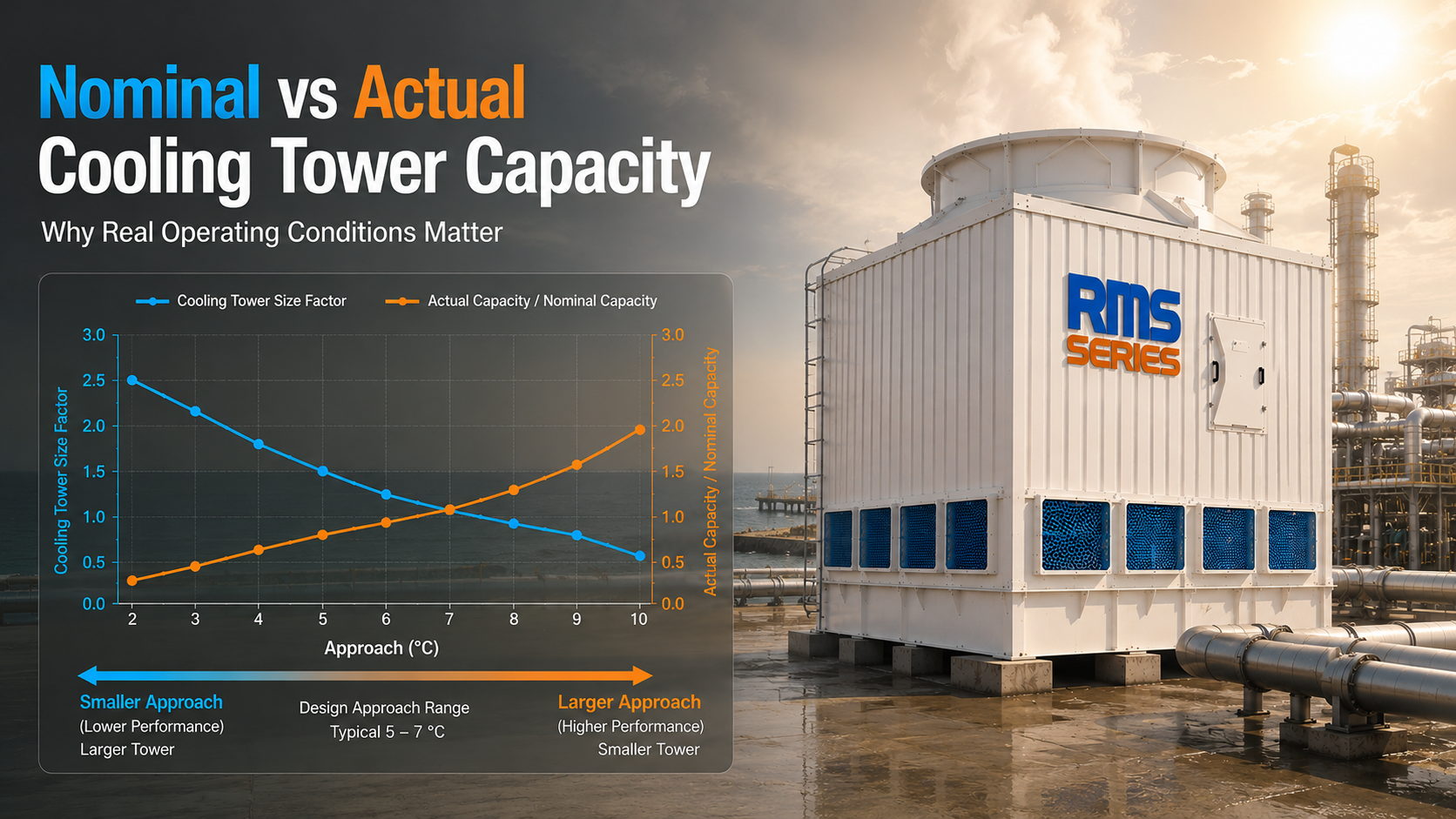
This means that two identical cooling towers with the same catalog rating can perform very differently when installed in different locations.
For example, a tower operating successfully in Shiraz, may struggle to achieve the required outlet water temperature in Basra, Muscat, Kuwait City, Doha, or Dammam during summer. The equipment itself has not changed, the operating environment has.
This is one of the most common reasons behind cooling tower underperformance in industrial facilities throughout the Middle East.
The problem is assuming that nominal capacity is the same as actual thermal performance.
Professional cooling tower manufacturers therefore begin every design with operating data rather than catalog ratings.
Typical design inputs include:
- Hot water temperature entering the tower
- Required cold water temperature
- Design wet-bulb temperature
- Circulating water flow rate
- Water quality
- Continuous or intermittent operation
Only after these parameters are defined can an engineer determine the required tower size, packing volume, airflow, fan power, and overall thermal performance.
This article explains why nominal refrigeration tons should only be considered a reference value and why actual cooling tower performance must always be evaluated using real operating conditions.
What Is Nominal Cooling Tower Capacity?
One of the biggest sources of confusion in the cooling tower industry is the use of nominal refrigeration tons as the primary method of classifying equipment.
These conditions generally represent HVAC applications with relatively small cooling ranges and moderate ambient wet-bulb temperatures. The rating methodology is defined in standards such as CTI STD-201 RS, which specifies the test conditions and performance acceptance criteria for evaporative heat rejection equipment (Cooling Technology Institute, 2013). You can use online cooling tower nominal capacity calculators to estimate nominal refrigeration ton.
Because the operating conditions are standardized, manufacturers can classify towers using simple catalog sizes such as:
- 100 RT
- 250 RT
- 500 RT
- 1000 RT
These ratings make product comparison easier.
However, they should never be interpreted as universal performance guarantees.
A cooling tower does not know its catalog rating!
It only responds to the amount of heat that must be rejected and the atmospheric conditions available for evaporation.
As soon as one of the operating parameters changes, the tower's actual performance changes as well.
For example, increasing the design wet-bulb temperature by only a few degrees can significantly reduce the cooling capability of an existing tower.
Likewise, increasing the required cooling range from 5°C to 15°C dramatically changes the required heat transfer surface, airflow, and fill volume.
The nominal rating printed in a catalog remains unchanged, but the actual thermal duty required from the tower becomes completely different.
This is why experienced thermal engineers rarely begin industrial cooling tower selection by asking for refrigeration tons alone.
Instead, they ask:
- What is the entering water temperature?
- What is the required leaving water temperature?
- What is the summer design wet-bulb temperature?
- What is the circulating water flow rate?
- Is the tower operating continuously?
- What is the water quality?
These questions determine the actual cooling requirement.
The catalog tonnage does not.
Why Nominal Cooling Capacity(RT) Can Become Misleading
Nominal capacity is not inherently incorrect.
The problem begins when it is applied outside the conditions under which it was originally defined.
This situation is particularly common in the Middle East.
Countries such as Iraq, Kuwait, Oman, Qatar, Saudi Arabia, and the UAE experience some of the highest summer wet-bulb temperatures in the world.
Although the dry-bulb temperature may exceed 50°C, the more critical design parameter for evaporative cooling is the wet-bulb temperature.
As wet-bulb temperature increases, the cooling tower loses part of its ability to reject heat.
This means a cooling tower capable of maintaining a specific cold-water temperature in a dry climate may no longer achieve the same result in a humid coastal region.
The equipment has not become defective.
The surrounding atmosphere simply provides less evaporative cooling potential.
This distinction becomes especially important in industrial applications such as:
- Refineries
- Petrochemical plants
- Steel mills
- Power plants
- Chemical processing facilities
- Cement factories
- Food processing industries
Unlike many HVAC systems, industrial cooling towers frequently operate with larger cooling ranges, continuous duty cycles, and higher thermal loads.
These applications require engineering calculations based on actual operating conditions rather than nominal refrigeration tons.
In other words, the same nominal cooling tower can deliver very different actual capacities depending on climate and process conditions.
Actual Cooling Tower Capacity: The Parameters That Really Matter
If nominal refrigeration tons cannot accurately predict cooling tower performance, what should engineers use instead?
The answer is simple: actual operating conditions.
Why Climate Has Such a Large Impact
One of the biggest misconceptions is assuming that air temperature alone determines cooling tower performance.
It does not.
The most important atmospheric parameter is Wet-Bulb Temperature (WBT).
Since cooling towers reject heat through evaporation, they cannot cool water below the ambient wet-bulb temperature or even closer than 2 degrees. As the wet-bulb temperature increases, the cooling potential of the atmosphere decreases.
This is why cooling towers installed in hot and humid regions require significantly larger heat transfer surfaces than identical systems operating in dry climates.
Consider the following simplified comparison.
Location | Typical Summer Wet Bulb | Cooling tower size factor |
Shiraz | Moderate | Medium |
Basra | Very High | High |
Muscat | Very High | Very High |
Kuwait City | Very High | Very High |
Doha | High | Very High |
Dammam | Very High | Very High |
Although some of these cities may have similar dry-bulb temperatures, their wet-bulb temperatures are considerably different, leading to substantial differences in cooling tower performance.
Range and the Amount of Heat Removed
Another parameter frequently ignored during preliminary equipment selection is Cooling Range.
Range is simply the temperature difference between the entering hot water and the leaving cold water.
For example
Entering water = 45°C
Leaving water = 30°C
Range = 15°C
A larger range means the cooling tower must remove more heat from every cubic meter of circulating water.
Many commercial HVAC cooling towers are designed around relatively small temperature ranges of approximately 5°C.
Industrial cooling systems are very different.
Steel plants, petrochemical facilities, power stations, chemical plants and heavy manufacturing processes frequently require much larger cooling ranges.
As the required range increases, the thermal duty increases proportionally, and the tower design must change accordingly.
Simply purchasing a larger nominal refrigeration tonnage does not automatically solve this problem and sometimes it may cause problem because of poor nozzles function.
The internal thermal design—including fill selection, airflow distribution, water loading and tower geometry—must also be optimized.
Approach: The Most important parameter in Cooling Tower Design
While Range describes how much heat is removed, Approach describes how close the leaving water temperature is to the ambient wet-bulb temperature.
Suppose:
Cold Water Temperature = 30°C
Wet Bulb Temperature = 27°C
Approach = 3°C
A small approach indicates excellent thermal performance.
However, every reduction in approach comes at a cost.
Reducing the approach from 6°C to 3°C is not a small design adjustment—it may require a substantially larger cooling tower, increased fill volume, greater airflow, and higher fan power.
This nonlinear relationship between approach and tower size is a fundamental concept in cooling tower design, extensively discussed in standard references on the subject (Burger, 1990).
For this reason, experienced thermal designers optimize the approach based on both technical performance and economic feasibility.
Attempting to specify an extremely small approach without increasing tower size usually results in disappointing field performance.
Cooling Tower Size Factor: Why a Small Approach Requires a Much Larger Tower
One of the least understood concepts in cooling tower engineering is the relationship between Approach and Cooling Tower Size Factor.
Many project specifications simply request a lower leaving water temperature without considering what this means for the physical size of the cooling tower.
From an engineering perspective, every degree of reduction in approach becomes progressively more difficult to achieve.
When the cold-water temperature approaches the ambient wet-bulb temperature, the driving force for heat and mass transfer decreases rapidly. As a result, the cooling tower requires a significantly larger heat transfer surface to remove the same amount of heat.
This relationship is commonly expressed by the Cooling Tower Size Factor.
Although the exact values depend on the thermal design method and manufacturer, every professional cooling tower designer observes the same trend:
- A large approach requires a relatively compact cooling tower.
- A moderate approach requires a larger fill volume and increased airflow.
- A very small approach may require a dramatically larger tower, even if the cooling capacity remains unchanged.
For example, reducing the approach from 6°C to 3°C does not simply increase the tower size by 50 percent.
Depending on the operating conditions, it may require nearly twice the thermal capability, resulting in a much larger tower footprint, greater fill height, larger fans, higher fan power, and increased structural weight.
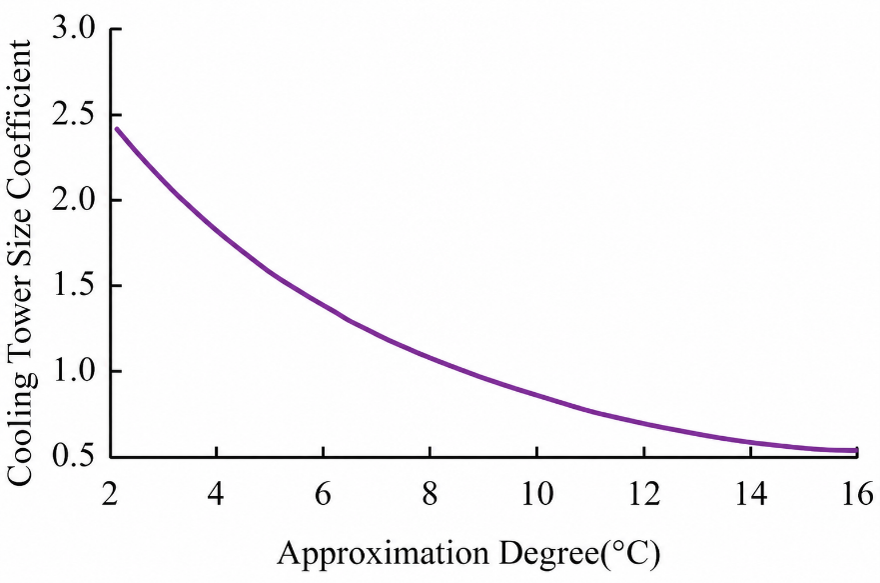
The Size Factor chart clearly illustrates that reducing approach becomes increasingly expensive from both thermal and economic perspectives.
In fact there are many charts to estimate the size factor using range, wet bulb and approach and they were used in past decades to calculate cooling tower size like this one.
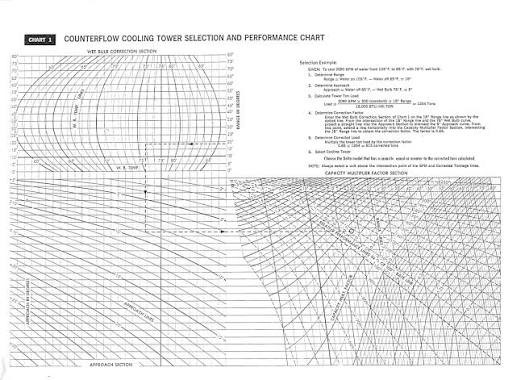
Today we use special design software to calculate waterloading, pressure drop, air velocity, fill height and type.
For industrial cooling systems operating in the Middle East, attempting to specify an unrealistically low approach without increasing tower size almost always leads to insufficient cooling during peak summer conditions.
Water Loading: The Parameter That Catalog Ratings Ignore
If there is one parameter that separates engineering-based cooling tower design from catalog-based equipment selection, it is Water Loading(Rain Density).
Most product catalogs classify cooling towers according to nominal refrigeration tons.
Professional thermal design, however, begins with water loading(Rain Density).
Water Loading (Rain Density) describes how much circulating water passes through a given effective fill area.
Instead of asking,
"How many refrigeration tons is this tower?"
Experienced engineers ask,
"How much water is flowing through the fill, and how efficiently can the fill transfer heat under these operating conditions?"
This is a fundamentally different design philosophy.
Water loading directly influences:
- Heat transfer efficiency
- Air-to-water contact time
- Fill performance
- Pressure losses
- Water distribution quality
- Drift characteristics
- Overall thermal efficiency
If the water loading is too high, water travels through the fill too quickly.
There is insufficient contact time between air and water, reducing evaporative cooling efficiency.
If the water loading is too low, the cooling tower becomes unnecessarily large and expensive.
The objective is therefore not to maximize or minimize water loading.
The objective is to determine the optimum water loading for the selected fill type, operating conditions, and required thermal performance. This approach follows the systematic design methodology for wet cooling towers, where water loading is a primary parameter for determining tower characteristics (Mohiuddin & Kant, 1996).
Professional cooling tower design software calculates this value automatically during the thermal design process.
Once the optimum water loading has been established, the engineer can determine:
- Tower plan area
- Overall tower dimensions
- Fill height
- Fill type
- Air velocity
- Fan diameter
- Fan power
- Airflow rate
- Drift eliminator configuration
This engineering workflow is fundamentally different from selecting equipment solely by nominal refrigeration tons.
Two cooling towers with identical catalog capacities may require completely different tower dimensions because their calculated water loading is different.
Nominal refrigeration tons may be useful for product classification, but water loading determines whether the cooling tower will actually perform in the field.
Case Study: Why the Same Cooling Tower Performs Differently in Different Climates
One of the easiest ways to understand the difference between nominal and actual cooling tower capacity is to compare identical equipment operating in different climates.
Imagine an industrial facility requiring the following cooling duty:
- Hot Water Temperature: 50°C
- Required Cold Water Temperature: 35°C
- Cooling Range: 15°C
- Continuous Operation
- 100 m3/h Water Flow Rate
Now suppose the same nominal 500 RT cooling tower is installed in several different locations.
At first glance, it might seem reasonable to expect identical performance because the tower model and process load have not changed.
In reality, the results can be dramatically different.
Accurate wet-bulb temperature data for each location is essential for proper design and can be found in standard references such as the ASHRAE Handbook (ASHRAE, 2020).

Scenario 1 – Shiraz
Shiraz has a relatively moderate summer wet-bulb temperature compared with many Gulf countries.
Shiraz max dry bulb temperature in summer:40 °C
Shiraz max wet bulb temperature in summer : 19 °C
Approach in Shiraz: 16 °C
Under these conditions, a 350-400 RT properly designed industrial cooling tower could be capable of achieving the required cold-water temperature with only minor design adjustments.
The nominal rating is relatively close to the actual thermal performance.
Scenario 2 – Basra, Iraq
Basra experiences extremely high summer temperatures combined with elevated humidity.
The higher wet-bulb temperature reduces the atmosphere's ability to absorb additional moisture.
Since evaporative cooling depends on evaporation, the tower loses part of its cooling capability.
Maintaining the same 30°C outlet water temperature now requires:
- Larger fill surface
- Increased airflow
- Lower water loading
- Larger fan capacity
- Greater tower dimensions
Without these changes, the tower may be unable to achieve the required process temperature during peak summer operation.
Basra max dry bulb temperature in summer:50-55 °C
Basra max wet bulb temperature in summer : 29 °C
Approach in Basra: 6 °C
In this case a properly designed 500RT-600RT cooling tower could reach 35 °C cold water outlet.
Scenario 3 – Muscat, Oman
Muscat presents similar challenges because of its coastal climate.
Although the nominal refrigeration tonnage remains unchanged, the available evaporative cooling potential is significantly lower than under standard rating conditions.
Simply selecting a "500 RT" tower from a catalog provides no guarantee that the required cold-water temperature can be maintained throughout the summer.
Muscat max dry bulb temperature in summer: 45 °C
Muscat max wet bulb temperature in summer : 32 °C
Approach in Muscat: 3 °C
In Muscat a properly designed 600-700RT cooling tower could reach 35 °C cold water outlet.
Scenario 4 – Kuwait City
Kuwait combines extremely high ambient temperatures with demanding industrial applications.
Refineries, petrochemical complexes and power plants often require continuous operation under maximum summer conditions.
Ignoring this parameter frequently results in insufficient cooling performance during the hottest months of the year.
Kuwait max dry bulb temperature in summer: 50 °C
Kuwait max wet bulb temperature in summer : 31.5 °C
Approach in Kuwait: 3.5 °C
In Kuwait a properly designed 600-700RT cooling tower could reach 35 °C cold water outlet.
Scenario 5 – Doha and Eastern Saudi Arabia
The same engineering principles apply to Qatar and the eastern coastal regions of Saudi Arabia.
These locations experience prolonged periods of high humidity, making wet-bulb temperature the controlling factor in cooling tower selection.
Designing a tower using nominal refrigeration tons alone may lead to significant underperformance once the project enters operation.
Doha max dry bulb temperature in summer: 47 °C
Doha max wet bulb temperature in summer : 32 °C
Approach in Doha: 3 °C
In Doha a properly designed 700RT cooling tower could reach 35 °C cold water outlet.
These comparative scenarios illustrate how the same nominal capacity can result in significantly different actual performance across climates. Recent studies have quantified this gap, confirming that nominal ratings alone are insufficient for accurate industrial cooling tower selection (Sustainability, 2023)
Engineering Based Cooling Tower Selection
Professional cooling tower design follows a structured engineering process rather than simple catalog selection.
A typical thermal design procedure includes the following steps.
Step 1 – Define the Process Conditions
The engineer first collects the project's operating data, including:
- Entering water temperature
- Required leaving water temperature
- Circulating water flow rate
- Design wet-bulb temperature
- Water quality
- Process heat load
These values establish the actual thermal duty of the cooling tower.
Step 2 – Perform Thermal Calculations
Specialized thermal design software is then used to evaluate the required cooling performance.
Rather than relying on nominal refrigeration tons, the software predicts the tower's performance under the specified operating conditions.
Step 3 – Determine the Optimum Water Loading
Based on the selected fill type and thermal requirements, the optimum water loading is calculated.
This value plays a major role in determining the tower's dimensions and thermal efficiency.
Step 4 – Select the Fill
The packing material is not selected solely by type.
Its height, geometry, and operating limits must also match the calculated water loading, water quality, and thermal duty.
Proper fill selection has a significant influence on cooling efficiency, pressure loss, maintenance requirements, and long-term reliability.
Step 5 – Determine Tower Dimensions
After the thermal calculations have been completed, the engineer determines:
- Tower footprint
- Fill height
- Air inlet area
- Fan diameter
- Airflow rate
- Fan motor power
- Drift eliminator configuration
At this stage, the cooling tower geometry is established according to engineering calculations rather than catalog classifications.
Step 6 – Verify Summer Performance
Finally, the design is verified under the peak summer design conditions.
This step confirms that the cooling tower can maintain the required outlet water temperature during the most demanding operating period of the year.
Only after this verification should the cooling tower be considered suitable for the project.
Conclusion
Nominal refrigeration tons provide a convenient method for classifying cooling towers, but they should never be treated as the sole basis for equipment selection.
Actual cooling tower performance depends on the interaction of multiple engineering parameters, including wet-bulb temperature, cooling range, approach, circulating water flow, water quality, and water loading.
This distinction becomes especially important in hot and humid regions such as Iraq, Oman, Kuwait, Qatar, Saudi Arabia, and other Gulf countries, where elevated summer wet-bulb temperatures significantly reduce the effectiveness of evaporative cooling.
For industrial facilities, selecting a cooling tower solely by its catalog tonnage can lead to insufficient cooling performance, increased operating costs, and expensive modifications after installation.
A reliable cooling tower should therefore be selected through thermal engineering calculations rather than nominal ratings.
By evaluating the actual operating conditions of each project, engineers can determine the appropriate tower size, optimize water loading, select the correct fill, and ensure dependable cooling performance throughout the most demanding summer conditions.
For more information please do not hesitate to contact us :
+989124780268
(WhatsApp, Telegram)
References
Cooling Technology Institute (CTI). (2013). CTI STD-201 RS: Performance Rating of Evaporative Heat Rejection Equipment. Houston, TX: CTI.
American Society of Heating, Refrigerating and Air-Conditioning Engineers (ASHRAE). (2020). 2020 ASHRAE Handbook—HVAC Systems and Equipment. Atlanta, GA: ASHRAE.
Mohiuddin, A. K. M., & Kant, K. (1996). Knowledge-base for the systematic design of wet cooling towers. Part 1: Selection and tower characteristics. International Journal of Refrigeration, 19(1), 43-51.
Burger, R. (1990). Cooling Tower Technology: Maintenance, Upgrading and Rebuilding (2nd ed.). Lilburn, GA: Fairmont Press.
[Authors]. (2023). Efficiency Evaluation of Different Cooling Tower Models. Sustainability, 15(22), 15454.