Cooling tower fill is one of the most important components in an evaporative cooling tower. Its main purpose is not simply to “increase the surface area” inside the tower, but to create a large and effective contact area between circulating water and moving air while providing sufficient contact time for heat and mass transfer.
This is why the surface area of cooling tower fill is often discussed when evaluating cooling tower performance.
However, several different terms are commonly used in this context, including specific surface area, effective surface area, wetted surface area, and sometimes evaporation surface area. These terms are related, but they do not necessarily describe exactly the same physical quantity.
Understanding the difference is important when selecting cooling tower fill, comparing film fill with splash fill, or evaluating the performance of an existing cooling tower.
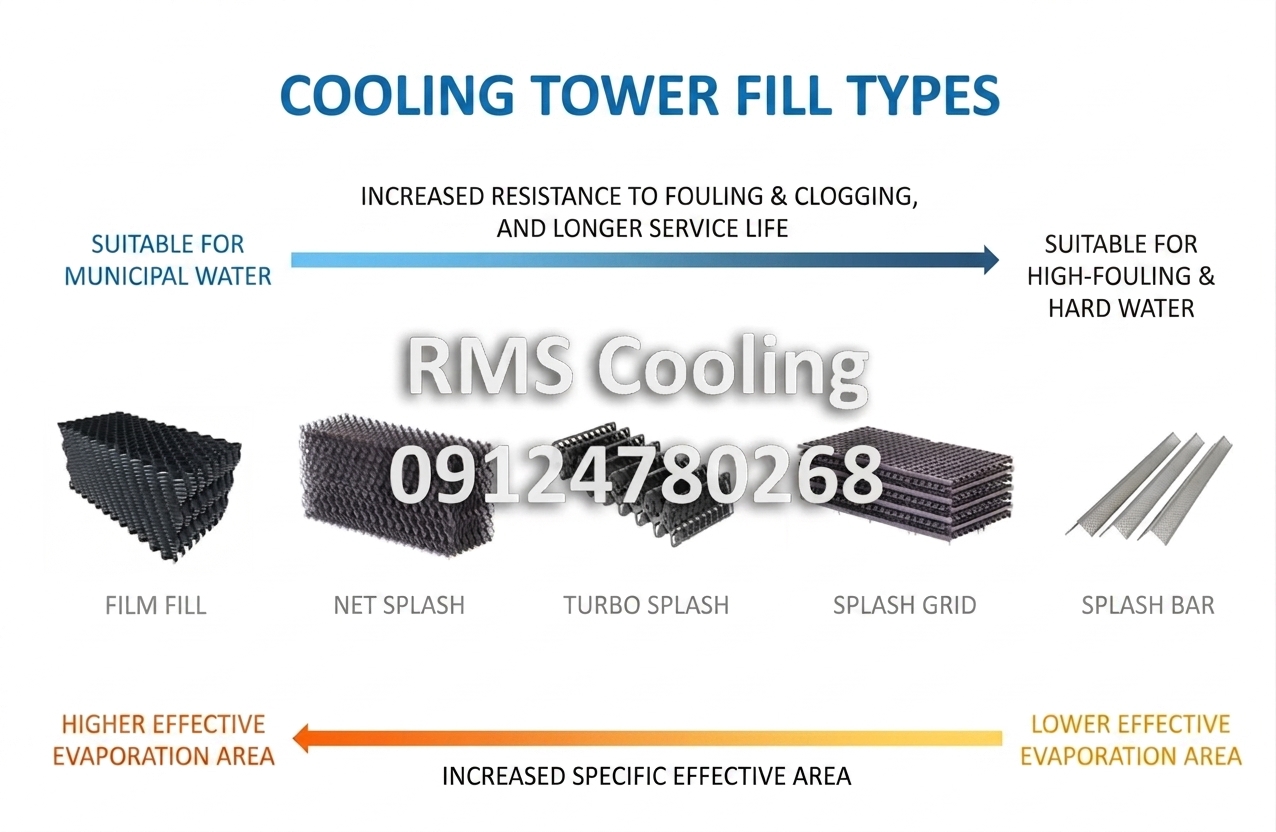
What Is the Surface Area of Cooling Tower Fill?
Cooling tower fill is the internal heat-transfer media through which water and air come into close contact.
In a film-fill cooling tower, water spreads over the surfaces of corrugated plastic sheets and forms a relatively thin water film. In a splash-fill tower, the fill repeatedly breaks the falling water into smaller droplets and streams.
The purpose in both cases is the same:
To increase the area and time available for air-water contact.
This contact allows sensible heat transfer from the water to the air and, more importantly, evaporation of a portion of the circulating water. The evaporation process removes a significant amount of heat from the remaining water.
Research on wet cooling tower fills describes the fill as a structure designed to increase the surface area available for air-water interaction while also influencing heat and mass transfer and air-side pressure drop.
Therefore, when engineers talk about the “surface area” of cooling tower fill, they are not simply referring to the geometric area of the plastic sheets or splash bars.
The effective area that is actually wetted and exposed to the air is much more important.
Specific Surface Area of Cooling Tower Fill
One of the most useful parameters for describing cooling tower fill is specific surface area.
It is generally expressed as:
m²/m³
and represents the available surface area per unit volume of fill.
For example, if a fill has a nominal specific surface area of:
150 m²/m³
this means that one cubic meter of the fill geometry provides approximately 150 square meters of geometric surface area according to the relevant definition used by the fill manufacturer.
Specific surface area allows engineers to compare different fill geometries without simply comparing their physical dimensions.
A fill block measuring 1 m³ may have a much larger internal surface area than a simple splash-bar arrangement occupying the same volume.
This is one of the reasons film fills can achieve high thermal performance in a relatively compact fill volume. Typical industry references show substantially higher effective heat-transfer areas for film fill than for conventional splash fill.
However, there is an important qualification:
A higher specific surface area does not automatically mean a better cooling tower.
The area must actually be usable.
Specific Surface Area vs. Effective Surface Area
This distinction is critical.
The specific surface area is primarily a geometric characteristic of the fill.
The effective surface area is the portion of that area that actually contributes effectively to heat and mass transfer under operating conditions.
Not every square meter of a fill's geometric surface will necessarily be:
adequately wetted,
exposed to sufficient airflow,
covered by a stable water film,
free from fouling,
hydraulically active,
or equally effective for heat and mass transfer.
Consequently, two fill products with similar nominal specific surface areas can perform differently in the same cooling tower.
The actual performance depends on several interacting parameters, including:
water distribution,
air velocity,
water loading,
air-to-water ratio,
fill geometry,
film thickness,
contact time,
temperature conditions,
fouling,
and pressure drop.
Modern research commonly treats the interfacial area between air and water per unit fill volume as an important parameter in the heat and mass transfer process.
What Is the Effective or Wetted Surface Area?
The wetted surface area refers to the portion of the fill surface that is covered by water during operation.
This is particularly important for film fill.
Imagine a corrugated PVC fill block. Its sheets may have a very large geometric surface area. But if poor water distribution causes part of the sheets to remain dry, that portion is not contributing to air-water contact in the intended way.
The result can be a significant difference between:
Geometric Surface Area
and
Effective Heat and Mass Transfer Area
This is why water distribution is just as important as the fill geometry.
A high-area fill with poor water distribution may perform worse than a lower-area fill that is uniformly wetted.
Is Cooling Tower Fill Surface Area the Same as Evaporation Surface Area?
Not exactly.
The expression “evaporation surface area” is frequently used in engineering discussions to describe the large area created to promote evaporation.
However, technically, it is better to distinguish between the surface of the fill and the air-water interfacial area.
Evaporation occurs at the interface between liquid water and air.
In a film-fill tower, the water forms a thin film over the fill sheets, so the air contacts the water film across a large area.
In a splash-fill tower, the fill breaks the water into droplets and streams. In this case, the surfaces of those droplets become the principal air-water interfaces.
This distinction explains why simply measuring the physical surface area of a fill does not provide a complete description of its thermal performance.
How Does Fill Surface Area Improve Cooling Tower Performance?
The cooling process inside an evaporative cooling tower involves both heat transfer and mass transfer.
The circulating water enters the tower at a higher temperature. Air passes through the tower and contacts the water.
As the contact between air and water increases, several things happen:
Heat is transferred from the water to the air.
A portion of the water evaporates.
The air becomes more humid.
The remaining circulating water loses heat.
The cooled water leaves the tower and returns to the process.
Increasing the effective air-water contact area can improve the opportunity for these processes to occur.
This is one of the fundamental functions of cooling tower fill.
The fill therefore acts less like a conventional solid heat exchanger and more like a contacting medium for air and water.
The primary heat transfer does not depend on the plastic or PVC itself conducting heat from one fluid to the other. Instead, the fill creates the geometry needed to maintain extensive air-water contact.
Film Fill vs. Splash Fill: How Is the Surface Area Created?
The two main categories of cooling tower fill are film fill and splash fill.
Film Fill
Film fill consists of thin sheets, usually arranged with corrugated or specially textured surfaces.
Water flows over the sheets and spreads into a relatively thin film.
The large surface of the water film provides extensive contact with the air.
The basic mechanism can be represented as:
Water → thin film → large air-water interface → heat and mass transfer
Because the fill can provide a large amount of surface area within a relatively small volume, film fill is commonly used when high thermal performance and compact tower dimensions are important.
However, the narrow passages between film-fill sheets can be vulnerable to:
suspended solids,
scale,
biological growth,
algae,
process contamination,
and other deposits.
When the passages become blocked, both airflow and water distribution can deteriorate.
This is one of the major trade-offs of high-area film fill.
Splash Fill
Splash fill uses a different mechanism.
Instead of maintaining a continuous thin film over closely spaced sheets, splash bars or similar structures repeatedly break and redirect the falling water.
The water is divided into smaller droplets and streams, increasing the air-water interface.
In simplified form:
Water stream → splashing → smaller droplets → increased air-water interface → heat and mass transfer
Splash fill generally has a lower specific surface area than high-performance film fill, but it can offer greater resistance to fouling and blockage in applications where water quality is poor.
This makes splash fill particularly useful for some industrial cooling applications.
Engineering references commonly distinguish the two fill types in this way: film fill relies on thin water films over sheets, while splash fill creates its effective contact area by breaking water into droplets.
Does More Fill Surface Area Always Mean More Cooling?
No.
This is one of the most important points when evaluating cooling tower fill.
It is tempting to assume:
More surface area = More cooling
But the actual relationship is more complicated.
Cooling performance depends on the interaction of:
effective contact area,
water flow rate,
air flow rate,
water distribution,
fill depth,
fill geometry,
temperature difference,
wet-bulb temperature,
air-to-water ratio,
pressure drop,
and water quality.
For example, increasing the surface area of a film fill may increase the potential for heat and mass transfer, but if the design also creates excessive air-side pressure drop, the fan may require more power or may not deliver the required airflow.
Similarly, a very high-area fill is of limited value if water distribution is poor or the fill becomes partially clogged.
Recent experimental work on splash fill also demonstrates that the fill zone's contribution to cooling performance depends not only on contact area but also on flow resistance, splashing behavior, and contact time.
Therefore, the correct engineering objective is not to maximize surface area at any cost.
It is to maximize useful heat and mass transfer per unit of fill volume and energy input while maintaining reliable operation.
The Importance of Water Distribution
Water distribution is one of the most overlooked factors when discussing cooling tower fill.
A fill block can have an excellent geometric surface area, but the tower will not achieve its expected performance if water is not distributed uniformly over the fill.
Consider two hypothetical fill blocks with identical geometry.
Tower A
High specific surface area
Uniform water distribution
Adequate airflow
Correct water loading
Tower B
Same fill
Poor nozzle distribution
Dry areas
Excessive water concentration in other areas
Tower B will not use the full available surface area.
Some portions of the fill may receive too much water, while other portions remain poorly wetted.
Therefore:
Fill area × water distribution × airflow
is much more meaningful than fill area alone.
How Fill Fouling Reduces Effective Surface Area
A new fill and an operating fill are not necessarily equivalent.
Over time, deposits can accumulate on the fill surface.
Common causes include:
calcium carbonate scale,
suspended solids,
corrosion products,
algae,
biological deposits,
and process contaminants.
These deposits can have several effects.
1. They reduce the available air passage
Blocked passages increase airflow resistance.
2. They change the water flow pattern
Instead of forming a uniform film, water may channel through preferred paths.
3. They reduce the effective air-water interface
Parts of the original fill geometry may no longer function as intended.
4. They increase pressure drop
The fan may need to overcome a greater resistance to airflow.
Therefore, a fill with a very high nominal surface area can lose much of its practical advantage if it is not suitable for the water quality.
This is why fill selection should always consider water quality together with thermal performance.
Typical Specific Surface Area of Cooling Tower Fill
There is no single specific surface-area value that applies to every cooling tower fill.
The value depends on:
fill type,
sheet geometry,
flute height,
corrugation angle,
spacing,
material thickness,
fill manufacturer,
and the definition used for the reported area.
As a broad engineering reference, conventional splash fills generally provide much less surface area per unit volume than high-performance film fills.
Published technical references have reported values around 70-130 m²/m³ for some splash fills and approximately 150 m²/m³ for certain film-fill configurations, while low-clog film fills may fall between these ranges. These values should be treated as representative examples rather than universal specifications.
Some modern commercial fill products are marketed with considerably higher nominal specific surface areas. However, comparing numbers from different manufacturers requires caution because the reported area may be defined differently.
For engineering selection, the manufacturer's thermal performance data under specified operating conditions is generally more useful than surface-area numbers alone.
Practical Examples of Cooling Tower Fill Surface Area
Commercial cooling tower fill specifications provide useful real-world examples of the difference between geometric surface area, effective heat transfer area, and effective surface area.
These terms should not automatically be considered interchangeable. Different manufacturers may define or report surface-area parameters differently, and therefore the numerical values should always be interpreted in the context of the manufacturer's technical documentation.
ENEXIO NF 20 / NET 150 Modular Splash Fill
A useful example is the NF 20 / NET 150 modular splash fill published by ENEXIO.
According to ENEXIO's technical specifications, this polypropylene (PP) splash fill has a geometric surface area of 450 m²/m³ and an effective heat transfer area of 128–130 m²/m³. The reported corrugation height is 20 mm, with a continuous operating temperature of 80°C and a short-term maximum operating temperature of 90°C.
| Parameter | ENEXIO NC 20 / NET 150 |
|---|---|
| Fill type | Modular splash fill |
| Material | PP |
| Geometric surface area | 450 m²/m³ |
| Effective heat transfer area | 128–130 m²/m³ |
| Corrugation height | 20 mm |
| Continuous operating temperature | 80°C |
| Maximum short-term operating temperature | 90°C |
ENEXIO also explains that water droplets fall from web to web and that the droplets suspended in the air between the webs provide additional exchange surface, contributing to the overall heat and mass transfer capability of the fill. The manufacturer positions this design for applications including brackish water, seawater, and dirty water.
This example is particularly valuable because it demonstrates that geometric surface area and effective heat transfer area are not the same parameter.
The 450 m²/m³ value should therefore not be interpreted as 450 m²/m³ of effective heat-transfer area. ENEXIO separately reports 128–130 m²/m³ as the effective heat transfer area.
This difference should not, however, be interpreted as simply meaning that the remaining geometric surface is "unused." The two values represent different engineering concepts and are obtained or defined on different bases.
Hewitech CF-19 Cross-Fluted Film Fill
A second useful example is the CF-19 cross-fluted film fill manufactured by Hewitech.
Hewitech specifies a 19 mm wave height for the CF-19 and reports an effective surface area of 150 m²/m³. The fill uses a diagonal channel structure and is available in polypropylene (PP) and polyvinyl chloride (PVC). The manufacturer also reports a free volume greater than 97%.
| Parameter | Hewitech CF-19 |
|---|---|
| Fill type | Cross-fluted film fill |
| Channel structure | Diagonal |
| Wave height | 19 mm |
| Effective surface area | 150 m²/m³ |
| Material | PP / PVC |
| Free volume | >97% |
| Standard dimensions | 2400 × 310 × 300/600 mm |
Hewitech describes the CF-19 as a high-performance trickle/film fill designed to provide optimized heat and mass transfer. The manufacturer specifically attributes its performance to its large effective surfaces and structured geometry.
The CF-19 example is particularly relevant to the discussion of effective surface area because the manufacturer directly reports 150 m²/m³ as effective surface area, rather than simply providing a geometric surface-area value.
The product is described as suitable for cooling towers and for clean to slightly contaminated water qualities, depending on the application and configuration.
Comparing Published Surface-Area Values
Putting these two commercial examples next to each other illustrates why surface-area numbers must be interpreted carefully.
| Manufacturer | Fill | Fill type | Published surface-area parameter | Published value |
|---|---|---|---|---|
| ENEXIO | NF 20 / NET 150 | Splash | Geometric surface area | 450 m²/m³ |
| ENEXIO | NF 20 / NET 150 | Splash | Effective heat transfer area | 128–130 m²/m³ |
| Hewitech | CF-19 | Film | Effective surface area | 150 m²/m³ |
The table should not be interpreted as a direct performance ranking of the three values.
For example, comparing 450 m²/m³ geometric surface area from ENEXIO directly with 150 m²/m³ effective surface area from Hewitech would not be an equivalent comparison. They represent different parameters. Likewise, the 128–130 m²/m³ effective heat transfer area reported by ENEXIO should not automatically be assumed to have exactly the same definition or measurement basis as Hewitech's 150 m²/m³ effective surface area.
This is an important point when evaluating cooling tower fill products.
A manufacturer may report:
- geometric surface area,
- specific surface area,
- effective surface area,
- effective heat transfer area,
- or other thermal-performance parameters.
The terminology and methodology behind these values must therefore be understood before using them for engineering comparisons.
Why These Examples Matter
The ENEXIO and Hewitech examples also demonstrate two different approaches to creating air-water contact.
In the ENEXIO splash fill, water is repeatedly broken into droplets and streams. ENEXIO specifically notes that droplets suspended between the webs provide additional exchange surface for heat and mass transfer.
In the Hewitech CF-19 film fill, the structured cross-fluted sheets create a large surface over which water can spread while air passes through the fill channels. Hewitech reports an effective surface area of 150 m²/m³ for this 19 mm fill.
Therefore, the cooling performance of a fill cannot be determined simply by asking:
How many square meters of surface area does the fill have per cubic meter?
A more meaningful engineering evaluation should consider:
- the definition of the reported surface area,
- effective air-water contact,
- water loading,
- air loading,
- fill depth,
- water distribution,
- heat and mass transfer characteristics,
- air-side pressure drop,
- fouling potential,
- water quality,
- operating temperature,
- and the manufacturer's thermal performance data.
For reference, the technical specifications discussed above are available directly from the manufacturers: ENEXIO Cooling Tower Components and Hewitech CF-19 Cross-Fluted Film Fill.
Why Fill Geometry Matters
Two fills can have the same nominal specific surface area but different thermal and hydraulic performance.
Important geometric characteristics include:
sheet spacing,
flute height,
corrugation angle,
surface texture,
channel geometry,
fill depth,
and orientation.
These characteristics influence:
water film thickness,
air turbulence,
contact time,
water distribution,
pressure drop,
and resistance to fouling.
The fill is therefore a carefully engineered air-water contact structure rather than simply a material with a large surface area.
Surface Area and Pressure Drop: The Engineering Trade-Off
Increasing the amount of internal surface area often means creating a more complex flow path.
That can improve contact between air and water, but it may also increase resistance to airflow.
The result is an engineering trade-off:
Higher contact area
can potentially improve heat and mass transfer,
while
Higher airflow resistance
can increase fan energy requirements.
Experimental studies of wet cooling tower fills have shown that air-side pressure loss is an important design parameter and varies with fill type, air mass flux, water loading, and fill height.
The best fill is therefore not necessarily the one with the highest surface-area specification.
The better question is:
How much useful cooling performance does the fill provide for the available airflow, water flow, pressure drop, and operating conditions?
How to Select Cooling Tower Fill
When selecting fill for a new cooling tower or replacing existing fill, several parameters should be evaluated together.
1. Cooling Duty
Start with the required cooling duty and operating conditions.
Fill selection should support the required:
hot-water temperature,
cold-water temperature,
water flow rate,
wet-bulb temperature,
range,
and approach.
2. Water Quality
This is particularly important.
Clean water may allow the use of high-efficiency film fill.
Water containing significant suspended solids, biological contamination, or process contaminants may require a more fouling-resistant fill design.
3. Specific Surface Area
A higher value can provide greater potential for air-water contact, but it should never be evaluated independently.
4. Fill Depth
Increasing fill depth increases the available contact path, but it also affects pressure drop and tower dimensions.
5. Air-Side Pressure Drop
The fan must provide sufficient airflow through the fill.
A thermally efficient fill that causes excessive pressure loss may not be the best overall solution.
6. Maintenance Requirements
The fill should be selected according to the expected operating environment and maintenance capabilities.
7. Material Compatibility
PVC, PP and other materials can have different temperature limits, chemical resistance, mechanical properties and service-life characteristics.
Can Cooling Tower Fill Surface Area Be Increased to Improve an Existing Tower?
Sometimes—but it is not a simple modification.
Increasing fill volume or replacing an existing fill with a higher-area design may improve thermal performance under suitable conditions.
However, the entire system must be considered.
A change in fill can affect:
airflow resistance,
fan operating point,
water distribution,
spray system loading,
pump requirements,
drift,
structural loading,
and maintenance.
If the existing fan cannot provide the required airflow through the new fill, the theoretical increase in heat-transfer area may not translate into better tower performance.
Likewise, if the water distribution system cannot wet the additional area uniformly, the added fill volume may provide little practical benefit.
For this reason, cooling tower fill replacement should be treated as an engineering modification rather than simply replacing one packing block with another.
A Practical Way to Think About Fill Surface Area
A useful way to understand cooling tower fill is to separate the problem into four levels:
Level 1 — Geometric Area
How much surface area does the fill physically have?
Level 2 — Wetted Area
How much of that surface is actually covered by water?
Level 3 — Effective Interfacial Area
How much of the air-water interface is actually contributing effectively to heat and mass transfer?
Level 4 — Tower Performance
How does that effective area translate into the required cold-water temperature under the actual airflow, water flow and atmospheric conditions?
This distinction explains why two cooling towers with apparently similar fill surface areas can produce different results.
The Most Important Point About Cooling Tower Fill Surface Area
The purpose of cooling tower fill is not simply to provide the largest possible surface area.
Its real purpose is to create an effective, stable and sufficiently large air-water contact area while maintaining acceptable airflow resistance and reliable operation.
Therefore, when comparing cooling tower fills, do not look at only one number.
Consider the complete picture:
Specific surface area
effective/wetted area
water distribution
airflow
contact time
pressure drop
water quality
fill depth
operating conditions
= practical cooling performance
A fill with a lower nominal surface area may outperform a higher-area fill if it provides better water distribution, lower pressure drop, better fouling resistance, or more suitable hydraulic characteristics for the application.
Conclusion
Cooling tower fill is the primary air-water contact medium inside an evaporative cooling tower. Its geometry creates a large interface between circulating water and air, allowing sensible heat transfer and evaporation to take place efficiently.
Specific surface area, usually expressed in m²/m³, is an important characteristic of fill geometry. However, it should not be confused with the effective or wetted surface area that actually contributes to heat and mass transfer during operation.
Film fill generally provides a much larger surface area per unit volume than conventional splash fill, which allows compact and thermally efficient cooling tower designs. Splash fill, however, can be advantageous where water quality, fouling resistance and long-term reliability are more important than maximum compactness.
The key engineering lesson is simple:
The best cooling tower fill is not necessarily the fill with the highest surface area. It is the fill that provides the required heat and mass transfer under the actual water quality, airflow, water loading, pressure-drop and operating conditions of the cooling tower.
For this reason, cooling tower fill should be selected based on thermal and hydraulic performance, not on surface-area specifications alone.